Egypt of Listening is Fundamental
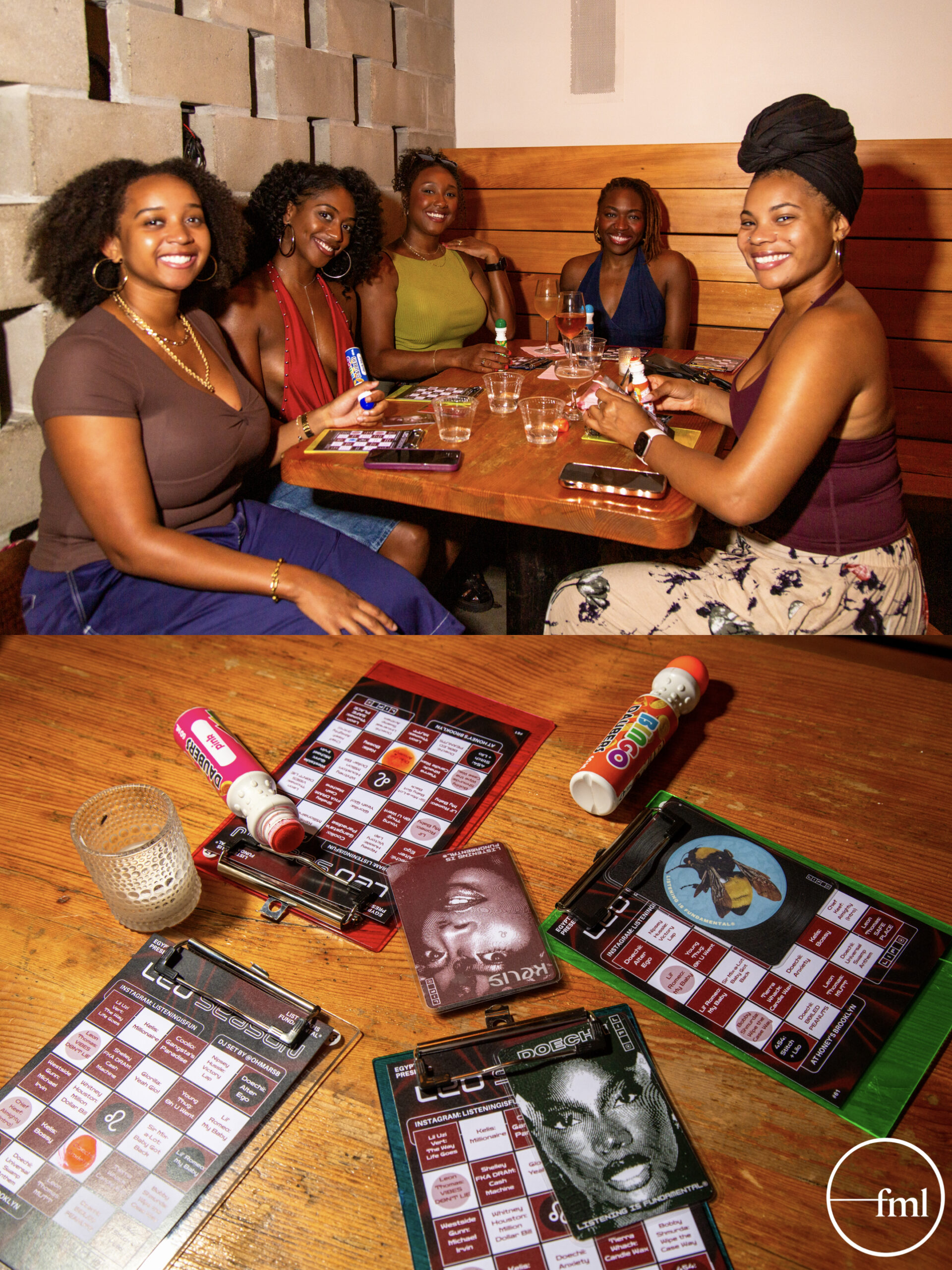
Brooklyn-based music curator, historian, and archivist Egypt Robertson is here to save us from two modern afflictions: a bad taste in music and a lack of third spaces. Her event series, Listening is Fundamental, transforms the age-old game of bingo into a college-level study of the history and cataloging of Black music.
On its surface, the concept is simple: Egypt plays a music sample, players identify the modern song in which the track is used, and then mark its corresponding bingo square. If you match five songs in a row, call bingo and win a prize. But more than a game, Egypt turns the solitary act of listening to music into something communal, refreshing, and, as bingo has always been, accessible to anyone who wants to play. Underneath lies a richer mission: to educate listeners about musicians who came before us, celebrate those creating now, and remain open to the sounds and people we have yet to meet.
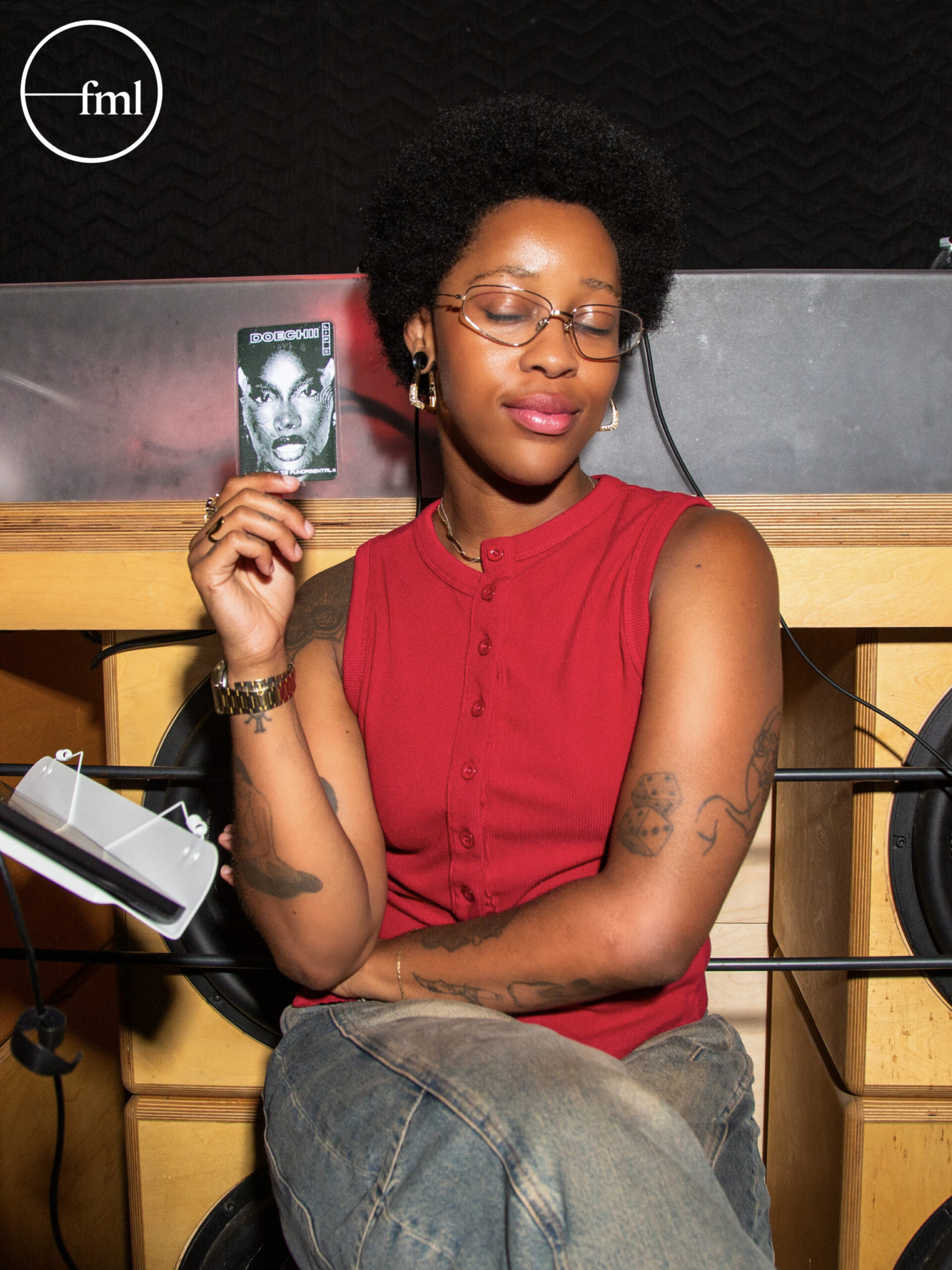
From printing zodiac-themed artist trading cards to commissioning local artisans to design prizes inspired by each session’s catalog, Egypt approaches every element of her events with thought and intention. Her ear is sharp, and her mind is well-studied, but it is her curiosity that becomes contagious as she takes us on a journey through sonic history, tracing a music sample through its lineage until a familiar record shines like an artifact cast in a new light.
Over the past year, LiF has celebrated a marathon of milestones. Highlights include event partnerships with Cooper Hewitt and The Met, a special appearance by Isaiah Rashad at a listening event in Los Angeles, and a third-anniversary party at SoHo’s Technica House.
For Egypt’s latest gathering, FML sat in at Honey’s in Brooklyn to literally learn how the game is played and watch what unfolds when listening fundamentally happens together.
FML: Tell me a bit about yourself. How do you describe what you do?
ER: I would describe myself as a problem solver. I would describe myself as somebody who is naturally inquisitive, but also very playful. What I do is a vessel for how my brain works and how I choose to showcase the information that I learn.
I like the fun facts that come with what happens in music because they show the connectivity among everything. I want to be the person who shows the connectivity.
FML: Before you became the music curator you are today, what did music feel and look like in your childhood?
ER: I listened to a lot of the radio growing up. For me, music was whatever was trending. I liked that, but I didn’t get into my own musical journey until I was a florist from 2020 to 2022. I worked next door to a record shop, and I would give them my money every Friday. That’s where the seeds of Listening Is Fundamental were planted.
To me, floral design is just a conversation of textures and shapes together, which is what style is, which is what graphic design is. It’s all the same; it’s just in a different format. That’s why I loved it. If you take the time to figure out what flowers you like, you can make really beautiful things.
FML: Was there a first song or album that made you curious about how music was made, not just how it sounded?
ER: I distinctly remember the day I learned what sampling, or copying, was. I was sitting in the car, and I think it was a Bryson Tiller, Rihanna, and DJ Khaled song. I was like, “This sounds like ‘Maria Maria.’” My ex at the time said, “Oh, this is a sample.” I was like, “Oh, so they can just do that??”
Then there’s “Fall for Your Type,” which is a song by Drake, but it was originally by Jamie Foxx. I remember hearing the original and thinking, wait. So you can take other people’s stuff, but then they give it to you, and you can repurpose it and use it on your own? This is cool.
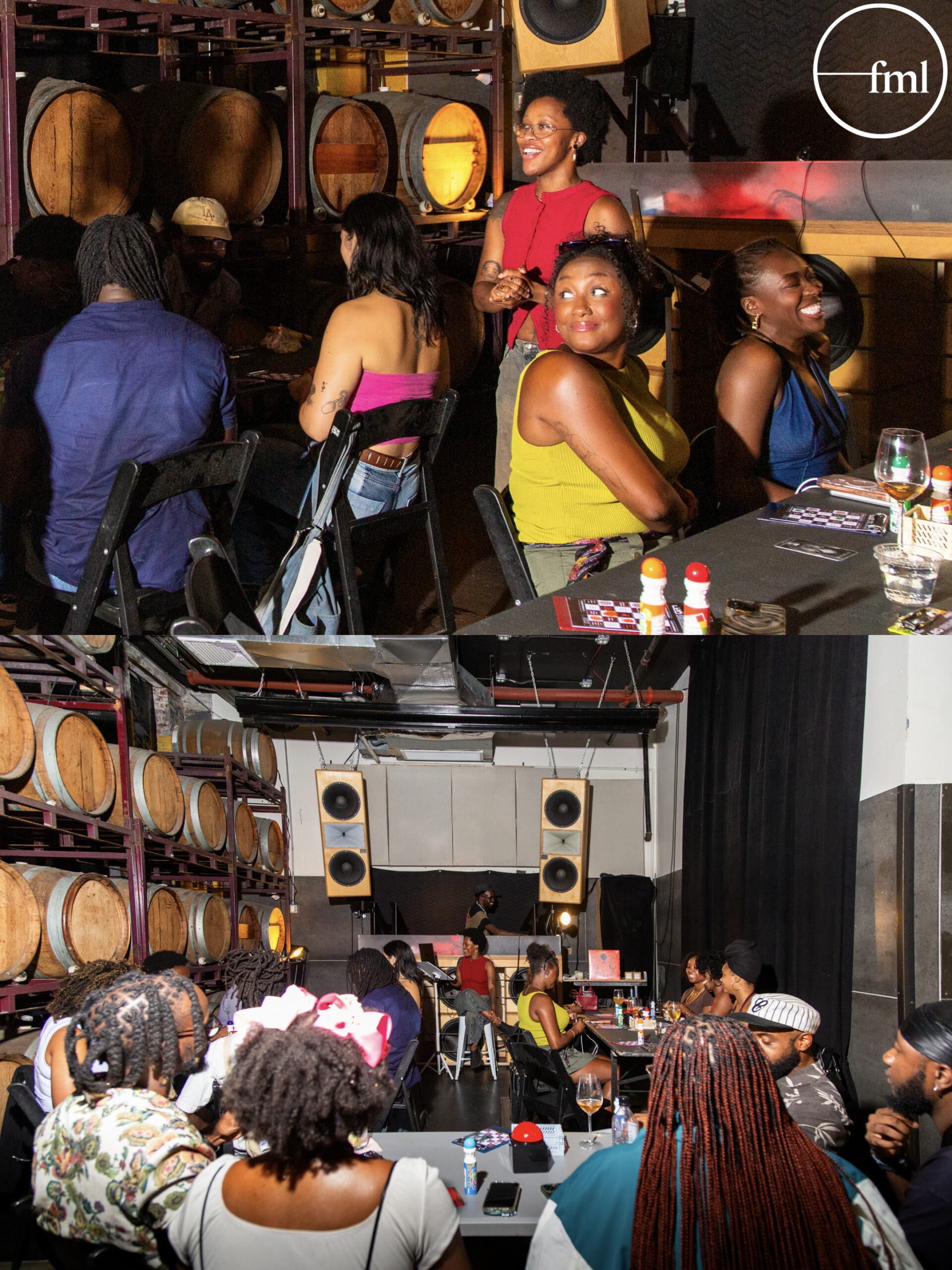
FML: What made you choose bingo as the right form for making the cultural history of sampling accessible?
ER: It’s inclusive of everybody. I don’t like being told I have to wait on my idea. I want to see it executed. I want to see how it grows. If I do a card game, I have to wait for things to get approved, and I want everybody to be able to play.
So, what is a fun way to paint the wheel a different color and give it different lighting so that it looks like a different shape? Bingo! I imagine someone calling “B-32” in Florida and at really long tables. It feels like an older game. But instead of it being an older game, how about we remix it and make it something intergenerational? That was the goal.
Also, just hosting fun! We don’t play a lot of games. Uno: people are not really friends. Not everybody likes Scrabble. I don’t play Monopoly. I’m so sorry. I don’t know how that game works… Those games are also very limited in how many people can play. I wanted something where as many as 100 people could play if they wanted to, and they have. Bingo is such an open format; that’s what I enjoy about it.
FML: Every event begins with an enormous amount of research on your end. How do you decide which themes, songs, trading cards, and prizes are right to include?
ER: Everything is a reference to something else. When I went to LA for the first time, I highlighted Kendrick Lamar’s discography because it was Gemini season. I thought, if I’m starting my tour and going to LA, I have to highlight Kendrick. It has to be during Gemini season. It has to be purple because of Prince, and he said that he’s Prince.
The cards have also evolved like Pokémon. In the beginning, they started as a collage of all the artists. Then I was talking with my friend Jimon, and he said, “What if you did it as a collectible trading card?” I was like, “You know what? That’s right, because I used to love Yu-Gi-Oh!”
All the research and designing is fun for me. I’m referencing something else so that people can do their own research later. I try to make references so people ask, “Why did you choose this color? What is this texture? Why did you choose this album to highlight?” I want you to do your homework later and maybe ask me more questions so I can share more information.
If I’m doing an artist catalog, I listen to them for maybe a week. I listen to them primarily all day. I find their SoundClouds, mixtapes, and EPs and just run through everything. I see if I hear old things or recognize any cadences, and then I go from there.
FML: You’re originally from Newark and now based in Brooklyn. How have those environments shaped your musical vocabulary?
ER: Being from Newark, the birthplace of Jersey Club, has really shaped me. As a kid, I didn’t dance a lot. I would watch people dance, which was really fun for me, but I don’t think I was only watching people dance; I was listening to the music.
My musical vocabulary has changed a lot because I’m learning what certain things are. Synthesizers are really big out in LA. I was like, “What is this sound I’m hearing? It sounds very West Coast. It sounds very LA.” My friend said, “Those are synthesizers.” Then there’s the bed squeak in Jersey Club. You have house and go-go music and all these different types of sound. I needed to learn the actual vocabulary so that when I’m telling people, “You’re listening for the drums, the hi-hats, the cadence in the lyrics,” I can explain what they’re hearing instead of just asking them to listen to the entire song.
I’ve also learned that recognition depends on the region. Certain things I play in New York are a hit here, and certain things I play in LA maybe didn’t cross over as far. When I went to Chicago, I did a board dedicated to Chicago. If I’m highlighting a Cancer artist like 6LACK, he’s from Atlanta. People in Chicago may not know his music because maybe that sound didn’t travel all the way. I think of it as a teachable moment because everybody isn’t listening to the same things all the time.
FML: What gets lost when Black music, or music generally, is heard without the history behind it?
ER: Where the song comes from. This song isn’t a year old; it’s actually 50 years old. We also lose all the people involved in making the song that we have today.
Maybe you sampled the horns from the Miles Davis quartet, but it actually wasn’t Miles Davis playing. Maybe he was orchestrating it, and somebody else whose name isn’t found anywhere is who you sampled. You don’t know that. That’s my job: to tell you that it was actually this person. Or, this producer worked on this project, and you may not know. People forget how many people are involved in making what we hear.
FML: At a time when so many people are searching for third spaces, what changes when strangers gather and listen together in a room?
ER: What changes is the objective of why everyone is actually in the room. Listening events are very popular right now. What makes mine different is that I’m asking you to actively listen together.
Yes, you are individually listening, but if you and the person next to you are like, “Wait, I know this,” now a conversation is being had. Yes, this is a game, and it is a competition, very, very low stakes, but you end up working together. Maybe you both know the song. You’re doing this individually while being together. It’s kind of like body doubling: you’re both trying to accomplish something together, but you’re doing it individually. Listening is something we take for granted.
FML: At your recent LA event, Isaiah Rashad walked into a room built around his own catalog. What was that moment like?
ER: One, it reminded me why I started this. This is a global artist who shaped our adolescence. We don’t have forums anymore where artists actually speak to their fans, or supporters, which is what I would call them. We support them by showing up to their shows, purchasing their merch, and purchasing their records.
Isaiah Rashad did a pop-up show at Elsewhere in May, and I gave him one of his old LiF cards. That was it. But then I was like, wait a minute, we actually have four full albums by this man. I’m doing an event next week. I planned it in a week. Stressed myself out, but I did it. It was great.
Then I made a video saying, “Where are all the Isaiah Rashad fans?” because I was doing this in New York. They were like, “Actually, we’re in LA.” I was like, okay! We’re going to LA again. We planned it in a month.
It was his birthday weekend, and ironically, my birthday was the day after the event. When he showed up, I was like, wow, this is actually kind of crazy. That was the best birthday gift I could get to close out that year.
FML: How do you protect your personal love of music when listening is also your research and your work?
ER: I’ve had to learn to turn my ears off. Music is playing all the time. Now I’ll Shazam a song or write it in my Notes app. I have a running note of the songs I hear, and then I do my homework during my study sessions.
I had to tell myself, you don’t have to do this right now. I know you’re excited to do this right now, but you don’t have to do this in this moment. You should be present in the moment you have been called to.
FML: You’ve described yourself as a “main team of one.” What do you want people to understand about what it takes to build Listening Is Fundamental?
ER: I love the fact that I take a chance and that I take a risk doing Listening Is Fundamental. I am not a nepo baby. I work very, very hard to put on these monthly events.
I used to do everything: the flyers, marketing, research, the design of the cards, and the design of the bingo board. I’m now working with a talented graphic designer named Zakiya. She helps me communicate what I’m trying to say through the flyers, and I want to give her her flowers. I’m also working on building a team.
If anybody is interested in reaching out to be a part of this, I’m open to that as well. Just because I love doing the job of five to seven people, imagine what I could do when I actually have five people. I think about collaborations like this: when you’re pitching yourself, how do you fit into the puzzle? Is fitting into said puzzle allowing you to get closer to the picture that you envision?
I can only see as far as my own vision. We all see things differently. I want to have conversations and really good soundboards for what Listening Is Fundamental could be. I want to dream big and envision something bigger than what I may even see for myself.
FML: When you imagine Listening Is Fundamental at its fullest scale, what do you see?
ER: It changes all the time! At its fullest scale, this would be a household game. I will figure out the lawyers, copyright, music, and protection to be able to do this. I would host a pop-up tour and travel with it for eight or nine months, doing different editions in different cities and countries.
I would do artist spotlights and have artists speak about the production, but I also want to talk with the mixing engineers and producers. I also imagine this being an online game show where I host it for rappers and singers. Let’s say we have Megan Thee Stallion do the Aquarius board. Denzel Curry and Lupe Fiasco are also Aquariuses, and now they’re having lunch.
But I’m happy. I’m happy I found something I’m passionate about. Listening Is Fundamental is not just a bingo game. It’s artist spotlights. It’s parties. It’s workshops. I’m happy to be building out the programming.
Three years is and isn’t a long time in my brain. It moves fast, but I’m like, okay, this is what I’ve been able to do in three and a half years, why not four? What does a full-year degree of Listening Is Fundamental look like?
By reinventing bingo, Egypt reveals the inherent reinvention baked into music sampling itself. Every remixed song carries whisperings of the past into the present, allowing sounds from one era of music to be reinterpreted by a fresh set of listeners. LiF moves us beyond the algorithms and hyper-curated digital spaces that keep us trapped within our own taste, and instead reawakens our innate human instincts: the desire to ask questions, connect with strangers, and play a game.
There is a long-held tradition of gathering to play, much like the long-held tradition of making and sharing music. Both fires have been kept alive by people returning to them and passing them along to those willing to listen.
“One of my favorite things is watching people who come by themselves leave knowing somebody,” Egypt says. “Yes, you came alone, but you don’t have to listen alone.”
In a world full of constant noise, Egypt’s events give us space to ground ourselves and return to music with intention. By gathering around those elemental fires, Listening is Fundamental reminds us to be human again.
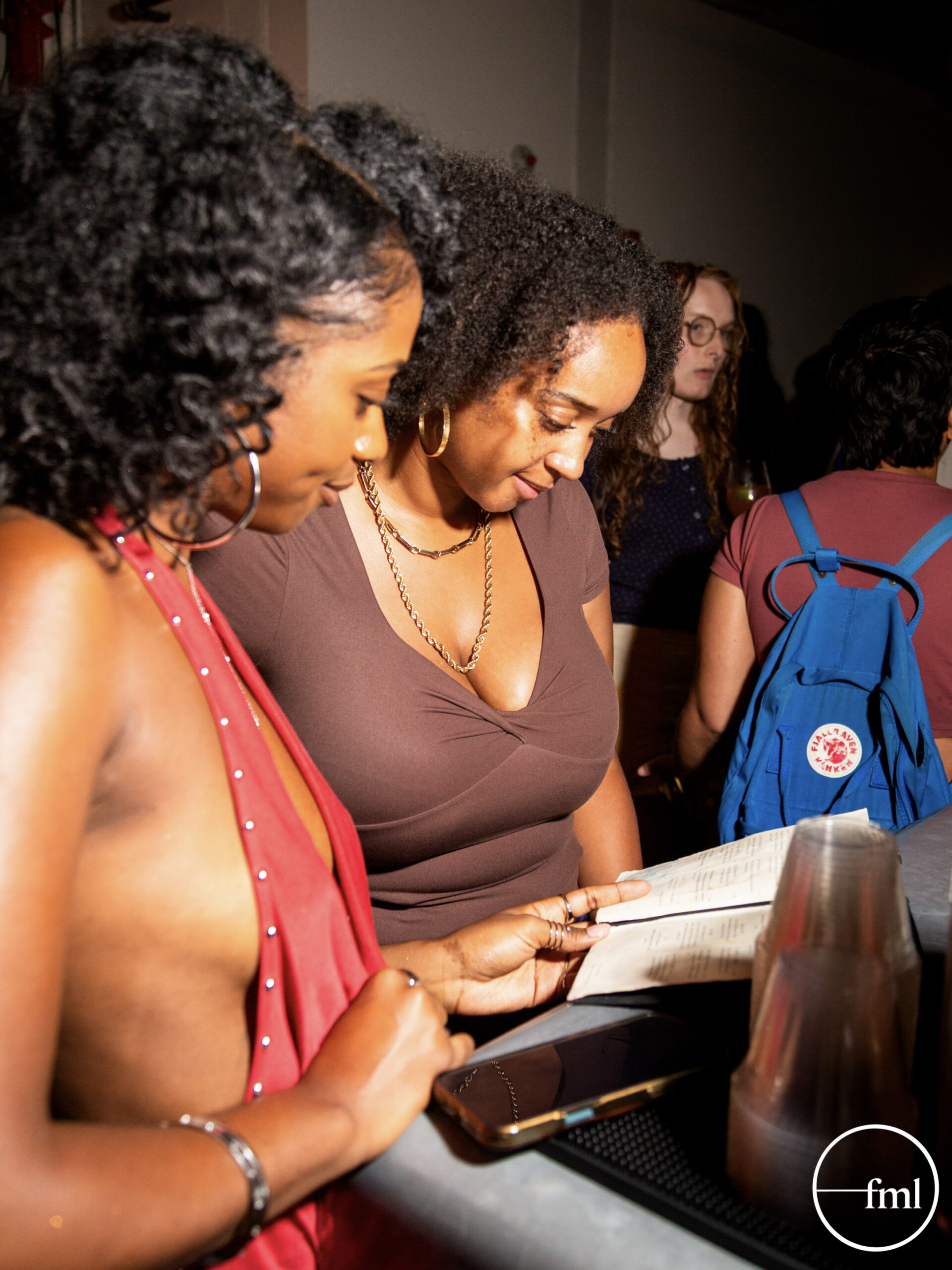
EGYPTS #FMLFaves
Favorite song? Right now on repeat, it’s torn between Esthero’s “Thank Heaven 4 You” and “Same Sh!t” by Isaiah Rashad.
Favorite vinyl? For image art right now, it’s The Whispers – Open Up Your Love.
Favorite movie? Spirited Away, Shrek, and Breakin’ All The Rules.
What’s in your bag? My Instax cam, photo book, Sharpie, 2 pairs of headphones, Uno cards, a cassette tape speaker, hand sanitizer, and lotion.
If you could only listen to one artist for the rest of your life, who would it be? Rest of my life? I’m not sure I’ve found them yet.
Most worn item in your closet? Right now, my collection of air rifts and my Japan souvenir bag from my friend Jimon.
Dream dinner-party guests? Tyler, The Creator, Jacqueline Woodson, Por Vida, Pierre Paulin, and DJ Screw
Favorite dish? Breakfast: Chocolate Chip pancakes with walnuts. Lunch: Sushi from Feels Seoul Good. Dinner: Right now, loving Lele’s Roman
EIC: Gina Kim-Park
Photography: Deki Namgyal
Interview: Abby Hricik