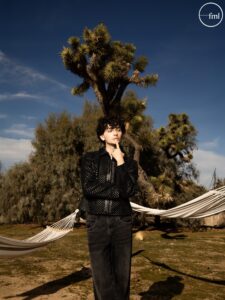
FML Designer Spotlight: Kuai Li of Quine Li
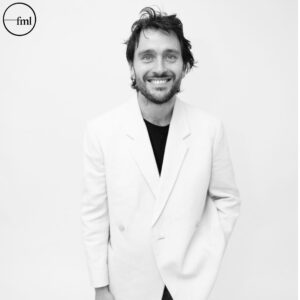
Kuai Li is a sculptor of movement, feeling, and space. Born in China and trained first in industrial design before turning to fashion, she approaches garments as spatial objects, engineered forms, and emotional extensions of the body. Her practice merges geometric precision with vibrant color, softness with architectural structure, and intimacy with spectacle.
Today, her work appears on major red carpets, editorial covers, world stages, and in the hands of global icons drawn to her unmistakable sculptural language. As the founder of her fashion label Quine Li, her rise has been both rapid and resonant, marked by emotional sincerity and experimental rigor.
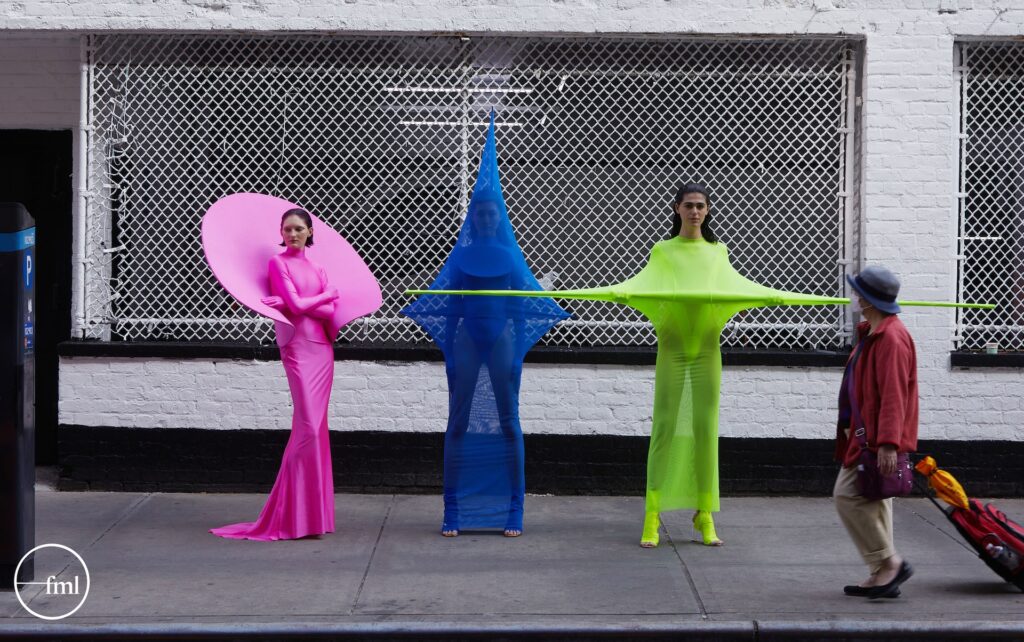
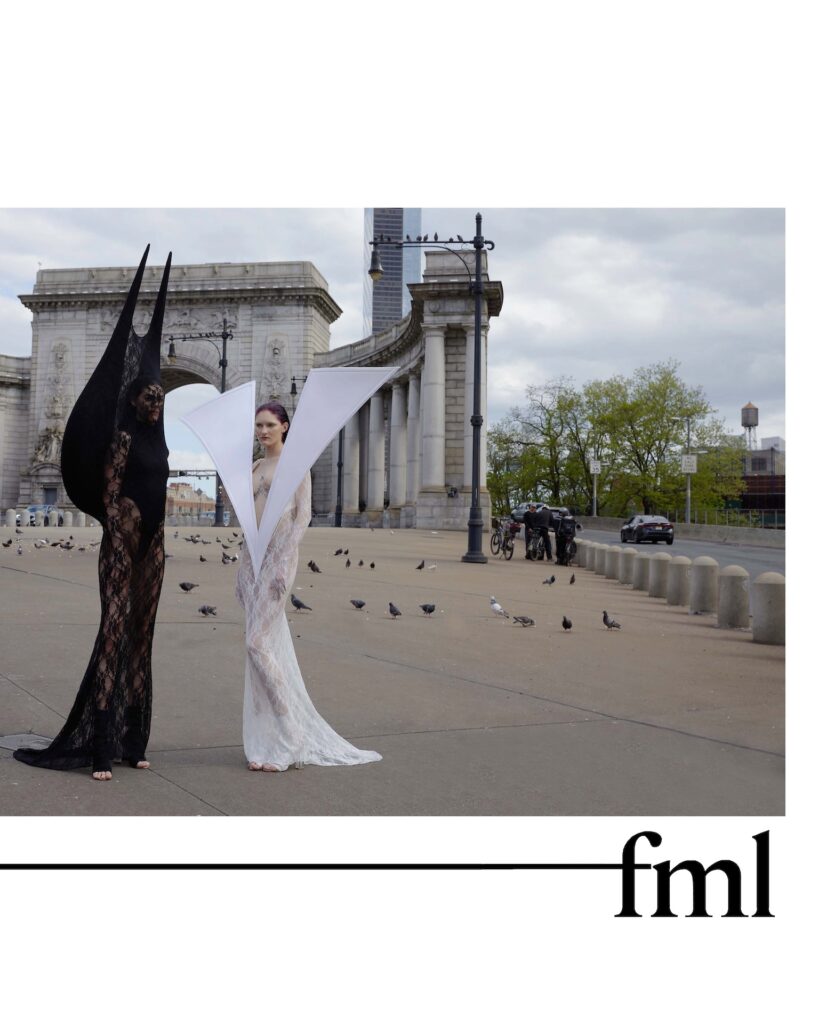
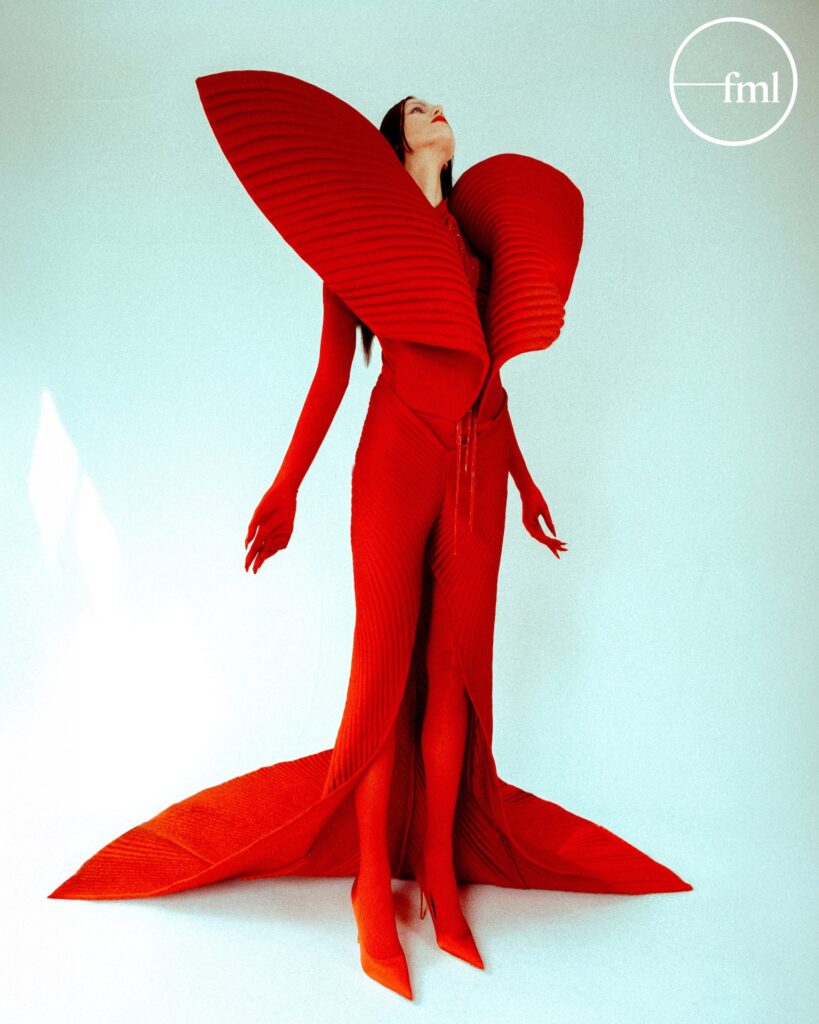
Photographer Siqiao Meng @killqiao, Stylist: Joao Pedro Assis @joaopedroassiss, HMUA Kaia Shi @kaiashimua, Model: Emma Deegan @user582549, Qianqian Dong @cccindy_daq, Veronica Zweiback @softronnie, Styling assistant Urvi Selarka @urviselarka, Yasmine, Hardy-Nie @yaz.onset
“Design is not something I put on the body. It is something I place in space, and the body completes it.” – Kuai Li
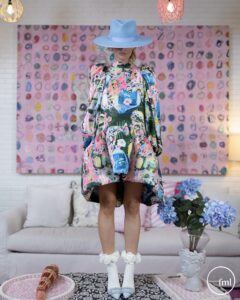
From her viral Toast Bag for Alloy to her widely embraced ready to wear collection Embrace Softness, Kuai navigates the delicate balance between commercial design and uncompromising artistry. Her Heart Shaped Collection has become a visual signature: playful, powerful, and rooted in her pure love for fashion.
Soft materials can express power. Hard materials can express confidence. There is no contradiction.
In this exclusive conversation with FML, Kuai Li speaks candidly about material exploration, sculptural experimentation, the emotional messages she hopes women feel when wearing her work, and the challenges of building an international career as a Chinese born designer. The Q&A below appears exactly as she shared it, offering an intimate look at one of fashion’s most forward-thinking creators.
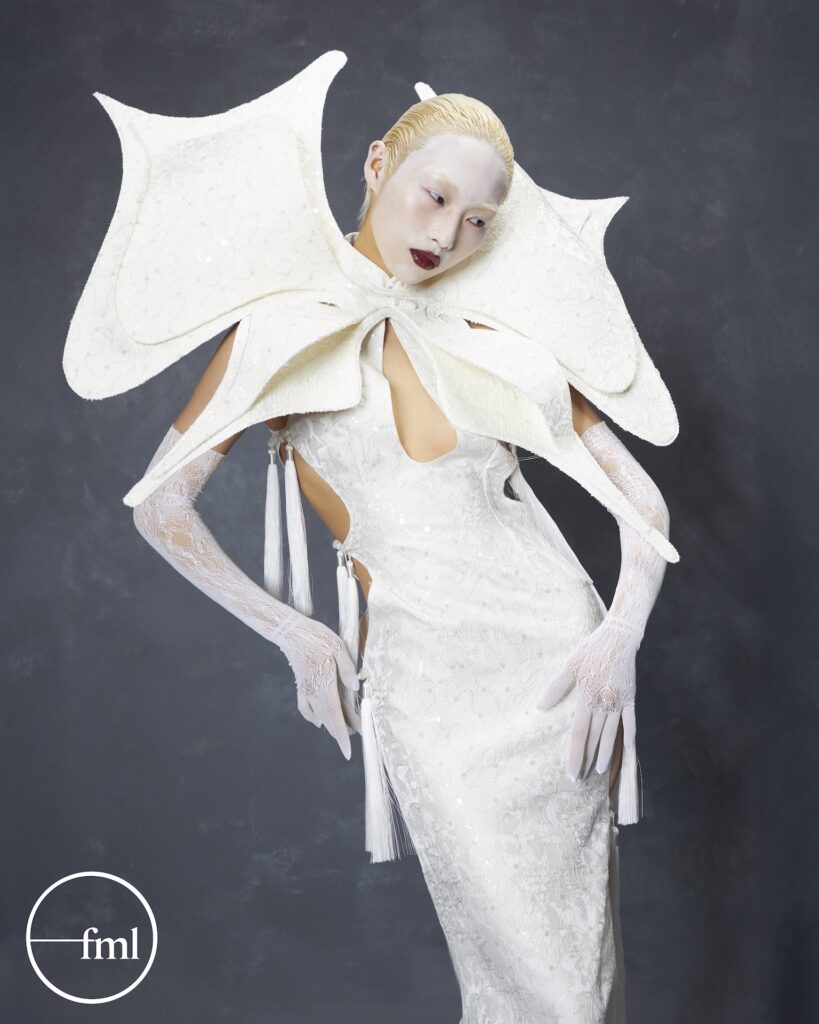
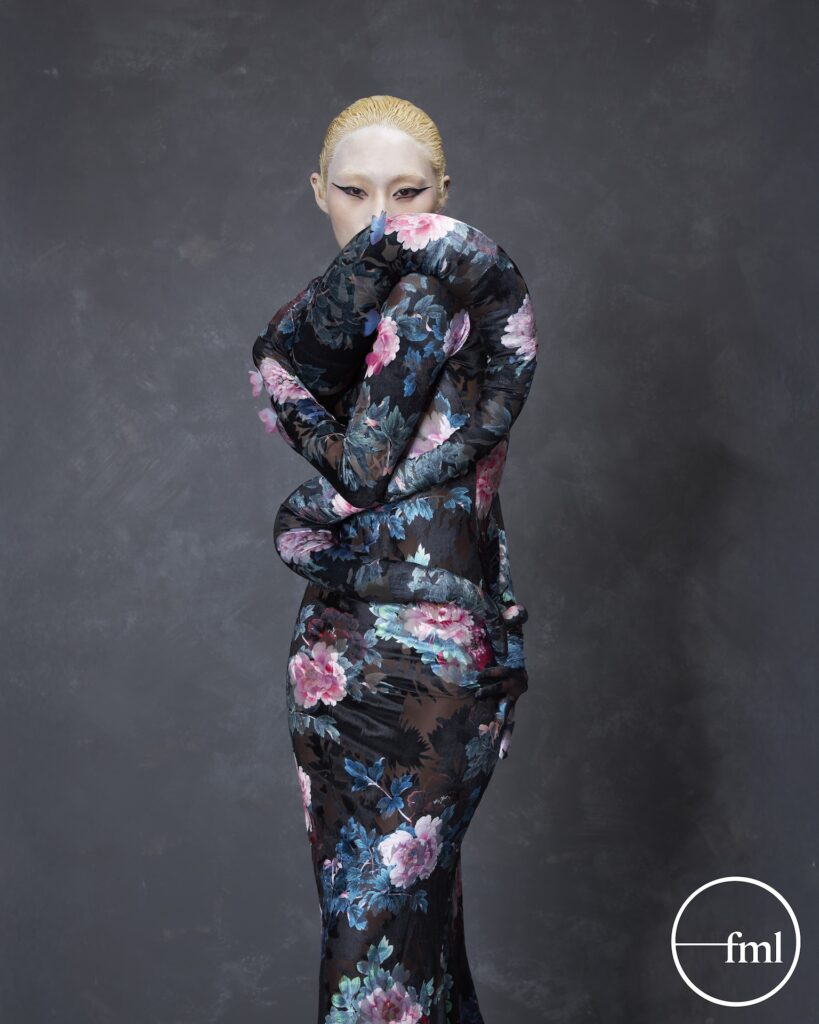
Photography: Yongqi Lui, Photo Assistant: Yvonne Chen, Model: Wawa Li, HMUA: Sophie Hartnett
FML: You were born in China and trained in both industrial design and fashion design.
How have these two disciplines shaped the sculptural aesthetics in your work?
KL: When I was studying industrial design, I loved finding inspiration from different
creative disciplines. Architecture, contemporary art, and sculpture were among my
favorites. Naturally, I became fascinated by the works of many outstanding designers
and artists, and I realized that these seemingly different fields actually share many
common elements. Their ways of perceiving beauty and provoking thought in the
audience have deeply influenced the development of my own sculptural aesthetics.
When I was working in industrial design, I was creating artful products; when I
design fashion, I’m creating artful garments. The only difference lies in their
functionality.
FML: What personal experiences most influence the way you think about the human body
interacting with space?
KL: When I was studying industrial design, I became particularly fascinated by space. I
didn’t want to create standalone products that existed without meaning — I wanted
them to interact with the user and coexist with their environment. Only through that
interaction can we truly discover the significance of an individual’s existence.
For example, one of my favorite architects, Le Corbusier, designed furniture to
accompany his architecture — creating a dialogue with space and forming a
harmonious atmosphere. When I design fashion, I see the wearer as a performer
within space. I hope they can sense the magnetic energy around them — the invisible
dialogue between the body, the garment, and the environment.
FML: Your work often merges industrial materials with softness. Where does that duality
come from in your artistic identity?
KL: I think it’s because I’m quite sensitive and perceptive — I can feel the beauty of
different materials. I like to explore their unique qualities and transform them into
clear sensory messages, such as softness, hardness, sharpness, or danger. I believe
design is a way of communicating; if the viewer or wearer can feel something, then
the design has truly succeeded.
FML: You approach fashion like industrial design. Can you walk us through how a
garment begins, from conceptual structure to its final wearable form?
KL: I have a design that’s over three meters long. I wanted to create a minimalist
silhouette—something that feels like a star emitting light. This piece explores the
relationship between the human body and space, inspired by tightrope performers who
balance with a long pole. To maintain balance at great heights, they must hold a long
rod — it’s both a performance and an aesthetics of equilibrium.
When I considered how to keep a three-meter-long structure perfectly straight while
allowing the wearer to hold it comfortably, I realized the material had to be slender,
rigid, stable, and lightweight. Obviously, this isn’t a typical garment material, so I
began exploring different material markets. My favorite place to go is Home Depot.At first, I found plastic tubes, but they bent under their own weight when held
horizontally. Then I discovered wooden rods — but they were too thick and difficult
to refine symmetrically, plus the weight wasn’t ideal. So I asked a staff member for
help, explaining the length, weight, and resistance to deformation I needed. He led me
to the construction materials area, near the warehouse — because such materials
wouldn’t appear in the regular retail section. There, I found copper pipes about three
meters long and two centimeters in diameter. Their strength and lightness were
exactly what I was looking for.
My ideal shape was thicker in the center and tapered to points at both ends. To
achieve this, I used high-density foam, attached it to the rod, and sculpted it into the
desired form. The whole process felt like creating a sculpture — repetitive, precise,
and meditative. I truly enjoyed it, because I could already envision the perfection of
the final piece. I trusted the material I had chosen. Isn’t that fascinating?
FML: Your designs often challenge physical expectations. What types of technical
experiments excite you most when pushing material boundaries?
KL: Each new design presents a fresh challenge in terms of material and structure. I have
to create tailored solutions for each one, and sometimes I feel like an engineer. Still, I
remain deeply fascinated by the charm of handcraft — the way it allows me to infuse
warmth into a piece, almost like sculpting with my hands.
FML: How do you decide when to use soft materials to express strength and when to use
harder materials to express confidence?
KL: I’m really glad that you can see both my softness and my confidence through my
work.
People are creatures of complex emotions, and so am I.
I have a gentle, tender side, and I also have a side that wants to express confidence
and strength. These two sides don’t contradict each other.
Which one I choose to show depends on the message I want to convey through a
particular piece or collection.
But whichever it is, it must be pure and genuine.
FML: What role do bold colors and geometric forms play in building the emotional
language of your designs?
KL: This is my visual language and my first principle.
My work is to create visuals, and I hope my audience can form a lasting impression
through strong visual symbols.
I also believe in the truth of geometry and numbers they are precise, enduring, and
resilient against both the passage of time and the fatigue of visual trends.
FML: Your Heart Shaped Collection became a recognizable signature of your brand.
What inspired this form and what does it symbolize for you?
KL: On an emotional level, this collection is entirely rooted in my pure love for fashion
design.
I transformed this feeling into the simplest symbol to convey a message that anyone in
the world can understand: love.In terms of form, beyond the heart shape, the pieces are also influenced by iconic
figures like the Kardashian silhouette. I wanted to exaggerate and amplify feminine
features celebrating the body, adding a sense of playfulness, and allowing the
wearer to feel proud of themselves.

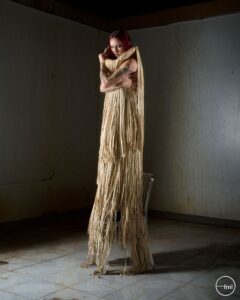
Photography @thandiroe, Talent @grracetaylorrr @katgjohnston, HMUA @nathangrossmakeup
FML: Your ready to wear collection Embrace Softness gained significant celebrity
attention. What message were you hoping to share through this collection?
KL: Embrace Softness was my first attempt at a ready-to-wear collection, and I didn’t
expect it to be loved by so many people.
Just like its name suggests, it’s about embracing softness treating the intimate act of
wearing clothes, which sit so close to the skin, as a form of embrace.
The soft, padded structures wrap around the body like arms holding you. I’ve asked
many people who have worn pieces from this collection, and they all described an
unexpected sense of softness, and even emotional comfort.
I love creating work like this pieces that close the distance between design and
wearer, allowing them to experience the beauty of design in a deeper, more intimate
way.
FML: You have dressed global icons including Bjork, Sabrina Carpenter, Ice Spice, Julia
Fox, Anok Yai, and Coco Rocha. How do you see these artists influencing the way
your work is perceived by the public?
KL: First, I want to express my gratitude for the opportunity to collaborate with so many
remarkable artists. I feel this is a truly important moment one that allows more
people to see my work. Through their interpretation, my creations are brought into
entirely new worlds. Outstanding teams and extraordinary artists have helped place
my work on larger stages, and I’m thrilled to witness new creative possibilities
emerging from these collaborations. I’m also delighted to see the public’s reaction. I
love the creative chemistry.
FML: You have also dressed major celebrities such as Megan Thee Stallion, Doja Cat,
Kylie Jenner, Katy Perry, Angela Zhang, Tyra Banks, and Michelle Yeoh. What does
it mean to you when these powerful figures choose to wear your designs?
KL: At first, I used to think it was just luck an unexpected opportunity that happened to
fall into my hands. But later, I realized I was good at making fashion, and they just
recognized it. That has been an incredible source of encouragement. Before studying
fashion design, I wasn’t sure if I could do it. Now I’m certain that I can.
FML: Juliette wore your work to the Brazil Vogue Ball in 2024. What was special about
creating for this event?
KL: This was an incredibly enjoyable collaboration Before this, I had already worked on
many projects with teams in Brazil, and everytime has been wonderful. You can truly
feel their passion for fashion and their fearless spirit.
Because timelines are always tight, they would always have someone personally pick
up the package and then fly it to Brazil. The UFO piece was extremely large and
prone to deformation, so I custom built a fully reinforced packaging box for it and
created detailed unboxing and usage instructions. The time and effort required for the
packaging far exceeded what it took to design the piece itself but it was absolutely
worth it
FML: When you design for celebrities for major moments, do you approach the process
differently than when designing pieces for your collections?
KL: It’s quite different. When designing custom pieces for celebrities, you have to focus
much more on wearability and flexibility so the outfit can adapt to various situations.
But when creating a collection, the work leans more toward experimentation.
FML: You have collaborated with major cultural figures including Kylie Jenner, Sabrina
Sato, Gessica Kayane, Geena Rocero, and others. How do these collaborations
challenge or expand your creative thinking?
KL: This is a great question. These collaborations happened quite early on, at a time when
I didn’t have much experience working with celebrities. But I could immediately feel
how professional their stylists were. For example, Kylie Jenner’s stylist, Mackenzie,
always gave me very clear and precise requirements. I could sense how accurately she
could predict the final outcome, and I was always impressed by the flawless looks she
created for Kylie. She truly understands Kylie and genuinely adores her.
Another example was when I created the red heart dress for Sabrina Sato. Her stylist,
Petro Sales, asked me if I could make it even more dramatic a bigger heart, a
bolder shape. That’s when I realized the design could be pushed further. That request
ultimately led to the later double heart silhouette.
In many ways, these experiences helped me grow. These stylists were like teachers,
offering invaluable advice that made me better.
FML: Your graduation collection at FIT became the finale of the 2023 MFA show and
was featured in Vogue Runway. How did that moment shape your confidence
stepping into the industry?
KL: I never really saw myself as a student. I simply wanted to create mature work.
So at first, I didn’t think the graduate show would bring me much, because I already
had many amazing collaboration projects before that.
But once the collection was featured on Vogue Runway, it reached a much wider
audience and received a great deal of attention and recognition.
That moment became the true, meaningful transition a perfect shift from industrial
design to fashion design.

Photographer Siqiao Meng @killqiao, Stylist: Joao Pedro Assis @joaopedroassiss, HMUA Kaia Shi @kaiashimua, Model: Emma Deegan @user582549, Qianqian Dong @cccindy_daq, Veronica Zweiback @softronnie, Styling assistant Urvi Selarka @urviselarka, Yasmine, Hardy-Nie @yaz.onset
FML: Your work has appeared in magazines such as Vogue, Harpers Bazaar,
Cosmopolitan, Interview, Wonderland, and many others. Which editorial
felt the most meaningful for your growth as a designer?
KL: I think it was the interview with Office Magazine at the end of my graduate studies.
Upasana Das reached out to me, and we had a delightful phone conversation about
half an hour. She was very curious about how I was still a student yet already
collaborating with so many celebrities. So I shared many of my experiences with her.
That interview became a reflection on my time studying fashion in graduate school
a perfect conclusion to that chapter, and the beginning of my journey as an
independent designer.
FML: What do you hope women feel when they wear your pieces?
KL: Fun confident Proud
FML: When part of your collection was copied by another brand, how did that
experience influence your perspective on originality, protection, and recognition for
emerging designers?
KL: After the experience of having my entire collection plagiarized, I consulted a lawyer.
Unfortunately, this kind of situation is very hard to avoid, and it’s also difficult to
hold the plagiarist legally accountable especially in international cases. As a self
funded student studying abroad at the time, I didn’t have enough time or energy to
pursue legal action. I ended up writing a long letter to the person who copied my work,
expressing my shock, criticizing her actions, and reaffirming my determination to
become a stronger designer. Looking back now, I realize how passionate I was.
Plagiarism is nothing more than self deception. The only thing you can do is become
stronger strong enough that the plagiarist becomes the clown.
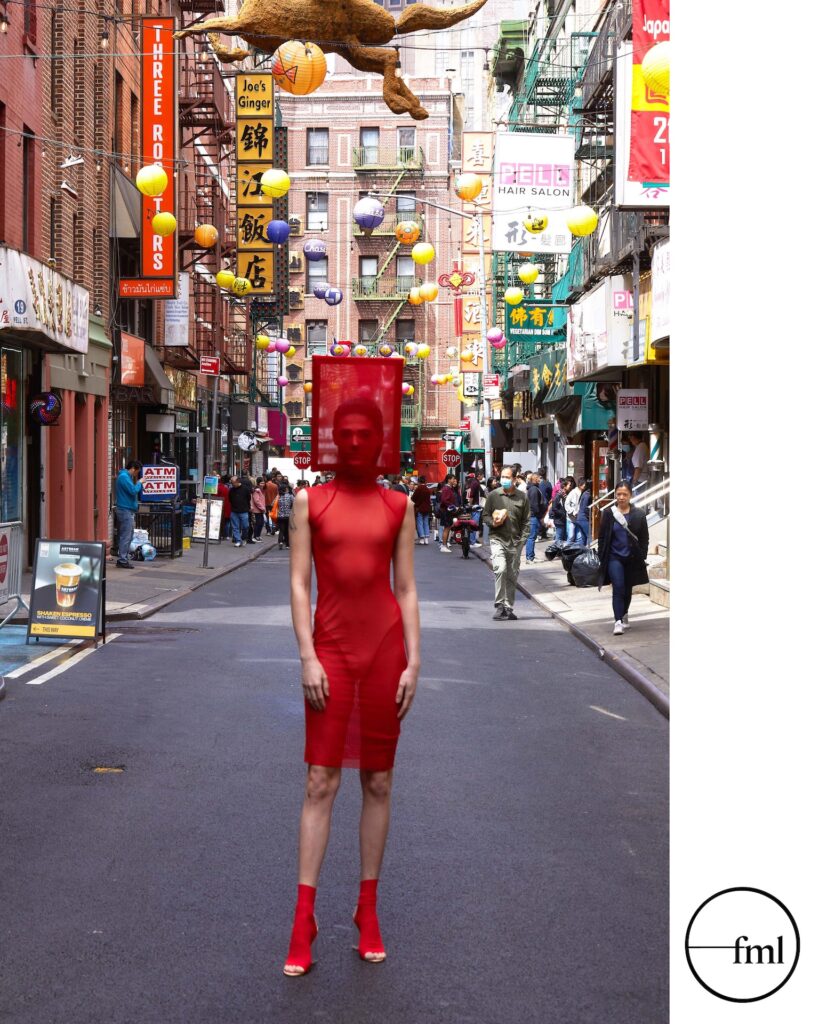
Photography @lost.myhorse, Model @grracetaylorrr
FML: What challenges have you experienced as a Chinese born designer building aninternational career in the fashion world?
KL: I felt challenged from the very moment I decided to study fashion a completely
new field for me. I funded my own education abroad, and during my graduate studies
I had to juggle my work in Beijing, build my own brand, meet all the academic
requirements, and complete internships. On top of that, I entered this program with
almost zero technical skills in fashion design. But guess what I accomplished
everything, and I did it exceptionally well. I think I’m someone who handles pressure
effectively and can overcome all kinds of challenges and difficulties. Of course, new
problems appeared after graduation too. Working as a fashion designer in New York
is not easy. If all I had to worry about was designing and creating, that would be a
dream.
FML: How do you maintain artistic integrity in such a trend driven and fast paced
industry?
KL: I think it comes from my constant love for the art I create and my enduring desire to
keep creating. I hope my work could be timeless, rather than something that exists
only as a product of current trends.
FML: Where do you see sculptural fashion evolving in the next decade, and what role do
you hope to play in that movement?
KL: I believe that the future of sculptural fashion will rely more on new technologies and
innovative materials. But I hope to convey a more primal sense of warmth and
reflection, rather than pursuing form for its own sake.
FML: Maureen Wroblewitz wore your piece for her FML cover story. How did you
approach designing the piece she wore, and what did that moment represent for you?
KL: This is a long, furry, square headed coat. As you can see, geometric elements appear
once again in my design. I turned the square shaped head into a decorative element
that merges seamlessly with the garment itself. Part of the inspiration comes from
Black hairstyles. They are incredibly skilled at shaping voluminous hair into all kinds
of dramatic forms, and I’ve seen styles sculpted into exaggerated, expressive shapes.
This design also continues a concept from one of my graduate works the yellow
square box structure built using almost the same principles of shaping and
reinforcement. The difference is that this time I used faux fur fabric that mimics hair,
making the piece feel almost alive and adding a sense of theatricality. It’s a new
experiment for me compared to my earlier purely geometric work, this piece
carries more emotion. I really love this design and the story behind the cover.
Kuai Li’s work reminds us that fashion can be poetic without losing precision, emotional without losing structure, architectural without losing humanity. Her sculptural language continues to expand, pulling from technology, craft, geometry, and instinct, yet always returning to the intimate relationship between garment and wearer. As she steps further into the global spotlight, her vision remains unwavering: to build designs that hold both strength and softness, both imagination and truth, and to create shapes that resonate long after the moment passes.