FML Music Spotlight: Tiger La Flor
There is the Los Angeles that exists now, crowded freeways, endless traffic, dreams being chased somewhere between East Hollywood and the Pacific. Then there is the Los Angeles Tiger La Flor would rather remember, even if she was never actually there.
It is 1974. The top is down on a convertible racing along Highway 1 at sundown. The radio is loud, the sunglasses are oversized, the boots are snakeskin, and somewhere between Laurel Canyon and Hollywood, romance still feels possible.
That version of Los Angeles is at the center of HOLLYWOODLAND, the new EP from Japanese-Korean-American indie pop artist Tiger La Flor, out now via Arista Records. Across five tracks, La Flor draws from the glamour and mythology of 1960s and ’70s California while telling a more contemporary story of romance, heartbreak, and chasing dreams in a city built around fantasy. She describes the project as “part fiction, part truth,” imagining herself as a glamorous variety-show star singing her way through a glossy, slightly cursed Los Angeles.
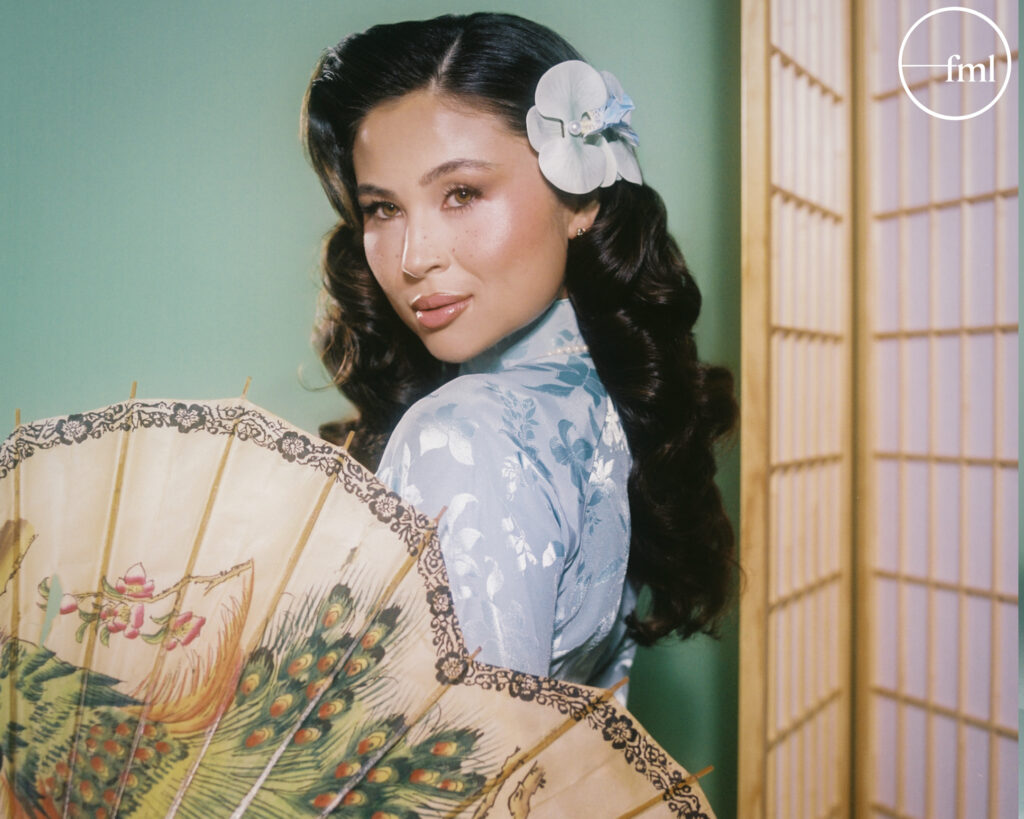
Photography by Andrea Riba
The idea began after La Flor returned to L.A. from Paris and started questioning what she actually found romantic about the city. Her answer came through another era. She built chronological playlists, researched period fashion, shot visuals on 16mm film, and developed what she calls her “Laurel Canyon Western” sound. HOLLYWOODLAND brings together the shimmering pop of ABBA, the California cool of Chris Isaak, country influences, live orchestration, and drums recorded to tape. In La Flor’s words, it is “like if David Lynch and Quentin Tarantino made country.”
The EP moves through the different stages and contradictions of romance, from the rose-tinted optimism of “KODACHROMATIC” to the sun-baked title track, the self-aware red flags of “BAD COMPANY,” and the difficulty of letting go on “IN COLD BLOOD.” “FOREVERMORE” closes the record with an unexpected meeting of Motown-inspired pop and mariachi horns. Beneath the cinematic references and vintage glamour, however, is a project rooted closely in La Flor’s own life. “Beneath all the glamour there is real heartbreak, yearning, and the peculiar melancholy of chasing dreams in a city that sells them,” she says.
HOLLYWOODLAND also brings together the worlds La Flor has been building throughout her career. The Old Hollywood fascination of 2024’s see me in hell meets the outlaw Americana of 2025’s Drugstore Cowgirl, shaped by an artist determined to place herself within musical and visual histories where Asian women have rarely been centered. That perspective has become an important part of La Flor’s work, not simply recreating the eras she loves, but finding a way to make them distinctly her own.
Already, “KODACHROMATIC” has taken on a life beyond the record, soundtracking viral posts documenting La Flor’s parents’ love story that have amassed more than 37 million views across social media. Now, with HOLLYWOODLAND fully out in the world, La Flor steps into her most realized era yet, balancing nostalgia with the very real experiences that inspired it.
FML got to chat with the HOLLYWOODLAND songbird about romanticizing Los Angeles, building her own version of the golden age, the heartbreak beneath the glamour, Asian representation, and what it means to keep fighting for the art she actually wants to make.
FML: HOLLYWOODLAND feels less like an EP and more like a lost film you’ve brought back to life. When did you realize you weren’t simply making a collection of songs, but building an entire world around them?
TLF: Honestly, with every EP, my goal is never just to make a collection of songs. I always start by asking, “What is the world I want to build?”
So with HOLLYWOODLAND, that was the intention from the beginning. The music is obviously the center of it, but then there are the characters, the fashion, the photography, the films, the colors, all of these things that start filling out the world around it.
I’ve just never been that interested in making music that exists completely on its own. I want you to be able to step inside one of my records and feel like you’ve gone somewhere.
FML: You’ve described HOLLYWOODLAND as a “nostalgic golden era of Los Angeles I never lived.” What do you think nostalgia allows us to romanticize that reality sometimes can’t?
TLF: I think nostalgia is almost always going to be a little more romantic than reality because reality is what you actually have to live through. Nostalgia is what you remember once time has softened the edges a little bit.
It’s kind of like reality through the warmth and grain of a disposable photograph. It’s technically the same thing that was standing in front of you, but somehow it looks softer and dreamier and a little more beautiful.
I think memory does that. You forget certain things and other things become almost mythological. And HOLLYWOODLAND really lives in that space for me, somewhere between what Los Angeles actually was and this golden version of it that exists in my head.
FML: Moving back to Los Angeles from Paris prompted you to ask what you actually found romantic about L.A. Did making this record ultimately change your relationship with the city?
TLF: Definitely. I think the act of making something your muse inevitably makes it more beautiful to you.
Any person I’ve ever written a song about becomes more romantic to me through the song. And I think the same thing happens with cities. You start actively looking for the things that are beautiful enough to write about.
That happened with Los Angeles. I was reading Joan Didion and Eve Babitz and watching movies like Once Upon a Time in Hollywood, and consuming all of this art made by people who had looked at the same city and found something inspiring in it.
It made Los Angeles go from being just the geographical place where I lived to my muse. And I think art does that. It makes you pay closer attention to things, and sometimes paying closer attention is what makes you fall in love with them.
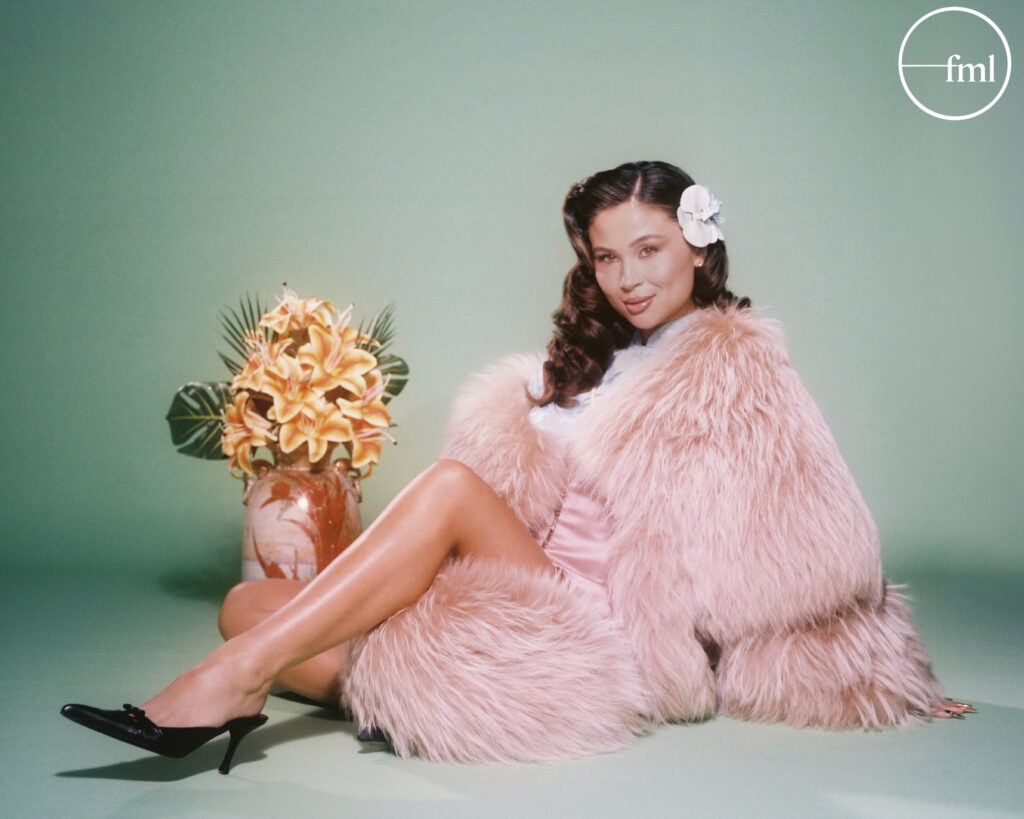
Fur: Valerian Hughes
FML: There’s a fascinating tension throughout HOLLYWOODLAND between glamour and unraveling. Why were you drawn to placing heartbreak inside such a beautiful, cinematic world?
TLF: I love that way of putting it.
I think heartbreak always comes out of something beautiful because your heart has to be full before it can break. You have to really love something, otherwise, what is there to lose?
I think glamour and unraveling naturally live together. And that’s why I wanted the world around these songs to be so beautiful. The more beautiful the dream is, the more heartbreaking it is to wake up from it.
FML: You describe the central figure of the EP as a glamorous variety-show star who borrows heavily from her author. Where does Tiger end and the character begin?
TLF: I’m actually becoming less and less sure, which is something I’ve been thinking about a lot lately.
I used to think there was Tiger, who is just me, and then Tiger La Flor, who was this character I created. But the longer I’ve been an artist, the less convinced I am that there’s a clean line between the two.
You hear artists talk about alter egos they become when they go onstage. But I think the funny thing is that if you inhabit an alter ego long enough, she starts changing you too.
So now I don’t totally know where one ends and the other begins. And I actually kind of like not knowing.
FML: You call your sound “Laurel Canyon Western,” pulling from ABBA, Chris Isaak, Dolly Parton, the Bee Gees, and vintage orchestration. How did you make such distinct references feel unmistakably like Tiger La Flor?
TLF: I always say I’m kind of a collage artist.
I have all these things that I love, and nobody else is going to have my exact combination of obsessions. When I listen to music, I’m always waiting for certain things. I want the Western guitar. I want the over-the-top string section. I want the cheeky ABBA-esque harmonies.
Dolly Parton was actually one of the biggest influences on this record, especially her vocal delivery. She had such a distinct vibrato and twang to her voice, and I really studied that when I was recording this EP. You can hear that influence throughout the record, but especially on “HOLLYWOODLAND” and in the chorus of “BAD COMPANY.”
She influenced the world around the record too. I spent so much time watching old footage of her on The Porter Wagoner Show while I was constructing the character and visual world behind HOLLYWOODLAND. Hearing today that she passed away made me reflect on just how much of this record traces back to her. She was such an icon, and I feel incredibly lucky that her work exists for generations of artists like me to keep learning from.
That’s kind of how I approach references in general. Instead of picking one influence and saying, “Okay, I’m going to make a record that sounds like this,” I’m more interested in asking, “Well, what if I put all of them together?”
You might hear Dolly somewhere, ABBA somewhere else, Chris Isaak or the Bee Gees, but I think the combination is what makes it sound like me. Maybe originality is sometimes just having really specific taste.
FML: You went deep into the visual research for this era, from chronological playlists and period fashion to shooting on 16mm. How important is fashion and image-making to the way you understand your music?
TLF: Completely inseparable.
Growing up, I basically had two dreams. I wanted to be a rock star, and I also wanted to be a fashion editor or stylist. So being an artist has weirdly allowed me to do both.
I’m also a huge music-history nerd, and when you look at the artists who became icons, you really can’t separate the style from the music. I love Cher, and so much of what we think of as that iconic Cher look came through Bob Mackie. Or even looking at early Lana Del Rey and the visual world her stylist Johnny Blue Eyes helped create around her.
I think there’s another level to artistry beyond making iconic music, which is having an iconic look. Cher, Elton John, Diana Ross, they weren’t just music icons; they were style icons.
So I think about that a lot with Tiger La Flor. I’m very heavily involved in the styling and creative direction, and for this rollout I even learned how to edit video and edited the music videos myself.
I get very obsessive about the visuals since, if I’m trying to build a world with a record, I can’t just deliver the soundtrack; I need to construct the film.
FML: You’ve said that life ought to be lived cinematically. What does living cinematically actually mean to you when there isn’t a camera around?
TLF: I deeply believe that the art you make is simply a reflection of the life you live. So if you want to make more cinematic art, you have to live a more cinematic life.
To me, that mostly means having the audacity to be the main character of your own life. Which sounds kind of corny now because “main character” became this whole internet thing, but I actually mean it pretty seriously.
You can spend your life acting like a background character watching other people do things and thinking, “God, I wish I could do that” or you can just go do it.
A lot of the major decisions in my life have made very little logical sense to people like my Halmoni, haha. I graduated from business school with an offer to work on Wall Street and instead chose to pursue music. I moved to Paris randomly because it’s been on my bucket list since I was a kid. I’ve walked away from things that were perfectly comfortable because some part of me still believed there was a more cinematic version of life out there awaiting me if I had the audacity to live with faith.
So I don’t think living cinematically is necessarily about buying flowers or romanticizing life in a traditional sense. It’s more about having the audacity to make choices from the lens of being the main character of your life.
FML: “FOREVERMORE” brings together influences from The Supremes and mariachi music in a way that feels unexpected but strangely natural. How did that sonic combination come together?
TLF: My thing is that I never want to make something weird just for the sake of being weird. I think you have to know the rules before you can break them.
When we made “FOREVERMORE,” it already had this very Motown, Supremes feeling to it, and I knew I wanted it to have that lush, wall-of-sound quality I love about ’60s pop.
But every time I listened to it, I was just like, “This needs mariachi horns.”
There wasn’t some super intellectual reason behind it. It just felt right. So suddenly we had this mariachi horn solo living inside this Supremes-inspired record, which is objectively kind of strange, but in the song it feels completely natural.
Those are usually my favorite decisions, when something maybe shouldn’t work on paper but your creative instinct is telling you it belongs there.
FML: “KODACHROMATIC” has become intertwined with your parents’ love story online, reaching millions of people. What has it been like watching something so personal to your family become part of other people’s ideas about love and nostalgia?
TLF: I think it’s really beautiful. I’m such a hopeless romantic. I genuinely think there are very few things in life more beautiful than true love, which is probably why I write so many love songs.
And I think we’re living in a difficult era for romance. My love songs are very idealistic, and they’re actually not usually based on my own experiences. A lot of the time I’m writing about the kind of love I believe is out there and that I still hope to find someday.
So sharing my parents’ story with “KODACHROMATIC” has been really special because their relationship is this reminder that the kind of love I write about doesn’t only exist in songs or movies. People actually find it.
And if somebody sees their story and feels a little more hopeful about love because of it, that means a lot to me.
FML: Your earlier projects explored Old Hollywood and then the American West, while HOLLYWOODLAND seems to bring those worlds together. Does this EP feel like the culmination of everything you’ve been building toward so far?
TLF: Yeah, completely. HOLLYWOODLAND feels almost like the marriage of the Old Hollywood world of See Me in Hell and the alternative-country, American West world of Drugstore Cowgirl.
I think every time you make a project, you get a little closer to your core as an artist. That’s why making records keeps getting more exciting to me. Every project teaches me something else about who Tiger La Flor is.
And HOLLYWOODLAND is definitely the closest I’ve gotten so far. It made me realize that all these things I thought were separate sonic and visual interests of mine actually belonged in the same world.
FML: You’ve lived in Seattle, Barcelona, Chicago, New York, Medellín, London, Los Angeles, and Paris, and you’ve said you inhabited a different character in each place. Which version of yourself feels most present on HOLLYWOODLAND?
TLF: HOLLYWOODLAND is definitely my Los Angeles record.
It was written here, the characters came from here, and so many of the emotions underneath it came from things I was experiencing in Los Angeles.
I’ve started thinking about my records almost like little time capsules of the different versions of myself I’ve been in different cities. Drugstore Cowgirl is my Seattle record because so much of its emotional history traces back there. HOLLYWOODLAND is the version of me who came back to Los Angeles and was trying to figure out what I found romantic about this city.
And without giving too much away, I think the next chapter belongs to Paris. That’s where I’m headed next, and my debut album is starting to pull me back toward that version of myself.
FML: You grew up loving rock & roll and country music while rarely seeing Asian women reflected in those worlds. Has creating that representation for yourself changed the way you think about belonging within a genre?
TLF: Definitely. Earlier in my career, I had a lot more imposter syndrome. I was asking for permission all the time.
When I was making Drugstore Cowgirl, I remember basically asking the producers and writers around me, “Am I allowed to make this record?” And thankfully everyone was like, “Who cares? Make the record.” So I did.
With HOLLYWOODLAND, I didn’t ask. There were still funny moments where I’d catch myself thinking, “Okay, I’m an Asian-American artist. Am I allowed to put a full mariachi horn solo in this song?” And eventually you realize you can’t spend your entire artistic life waiting for somebody to give you permission.
What does matter to me is understanding where my influences come from. If I’m pulling from another culture or musical tradition, I want to know its history and acknowledge and respect the people who created it.
I guess I used to wonder whether there was space for someone who looked like me in rock & roll or country or Americana. Now I’d rather just make the record.
FML: Drugstore Cowgirl partly came from your frustration with the lack of Asian representation in country music. With HOLLYWOODLAND, do you still feel like you’re challenging ideas about who gets to occupy these distinctly American musical and visual archetypes?
TLF: Representation is always somewhere in my head when I’m making art, but I think it shows up differently with every project.
With Drugstore Cowgirl, it was much more overt. Being an Asian woman making a country-influenced record felt bold to me at the time, so I wanted the imagery to feel bold too, like the album cover wearing a belt as a bra.
With HOLLYWOODLAND, it was a little subtler. I wanted the album artwork to look like an old Hollywood record or movie poster, but I wanted my heritage inside that world too. So we put Japanese lettering on the cover even though none of the songs are in Japanese.
And it was very hard to find American records that mixed English and Japanese typography in the way I was imagining. I found a few old RCA records that became references. I was also really inspired by The Supremes’ Where Did Our Love Go. I’ve always loved that cover, especially the green. Green is so underused in album artwork.
So I was basically taking this very classic American record language that I loved and figuring out how to put myself inside of it.
And hopefully this whole conversation becomes incredibly dated. I would love for somebody to read this years from now and be like, “Why would anyone have thought it was weird for an Asian-American woman to make country music?” That would be great.
FML: Your first EP came out of a period when you were running out of savings and struggling to find people willing to believe in the project. Now you’re releasing HOLLYWOODLAND with Arista Records. What part of that earlier version of Tiger are you determined to protect as your career grows?
TLF: Probably the part of myself that cares almost irrationally about every detail because they truly want to make something iconic.
The funny thing I’ve learned as my career has grown is that you can have an amazing team around you, but nobody is ever going to care about your art exactly as much as you do. And they shouldn’t have to since it’s your dream.
Nobody else is going to fight quite as hard for the weird song you know needs to be on the EP (which for me was FOREVERMORE), or obsess over whether the mix on the horn solo is exactly right, or care about the master EQ and the exact strings player on your record, and the font color, and all these tiny details, the way you do.
When I was struggling to get anybody to believe in my project, all I wanted was for somebody to give me an opportunity. And then once people do believe in you, there’s suddenly this completely different pressure because now you want to prove that they were right to give you a shot.
And that pressure can make you want to play it safer because the stakes feel higher, and you become much more aware of what might be commercially viable. I think it actually takes a lot of courage to hold onto your artistic vision, especially when you’re not seeing immediate success.
I’ve really shifted mentally toward playing the long game as an artist. Of course I hope the work I make is recognized in my lifetime, but the truth is so many of my favorite artists and writers I discovered long after their work was originally released. So I’m less concerned with whether something feels commercially viable right now. I care much more about building a body of work that I can imagine someone discovering forty years from now and still finding something in.
I have this faith that good art eventually finds its time. Maybe that happens immediately, maybe it happens ten years later, maybe it happens long after I’m gone. I can’t really control that part. What I can control is making work I’m deeply proud of.
FML: You’ve said, “It’s a daily fight to be an artist and have what you actually care about come out.” What are you fighting hardest to preserve in your work right now?
TLF: Honestly, myself.
I love watching old interviews with artists I admire, like Jeff Buckley or Kurt Cobain, and what always strikes me is how sensitive they seem. They’re deeply emotional, empathetic people. There’s this tenderness underneath the work.
And the older I get, the more I realize that protecting that sensitivity is actually part of protecting what makes you capable of being a true artist. I don’t think people talk enough about the mental and spiritual side of being an artist. Especially right now. AI is changing the creative landscape, social media scrutiny is insane, it’s expensive to survive, and there’s this feeling that artists are increasingly disposable. You can be the most exciting person in the world one day and everyone has moved on the next.
Meanwhile, you’re still carrying around this dream that, for most artists, has been placed on your heart since you were a kid. It’s your calling. And you spend your career handing little pieces of that dream to other people and trusting them with it. People come into your world and leave. Things fall apart. You rebuild them. I went through three different management teams just in the time it took to make this EP, and there were moments when I genuinely didn’t know if the project would ever be finished.
So when I say being an artist is a daily fight, I think I mean it spiritually as much as anything else. I’ve become a much more spiritual person since doing music full-time because I’ve realized how much work it takes to preserve the part of yourself that can still be moved by things.
I really believe artists are channels for something beyond themselves. I don’t know exactly what everybody would call that thing, but those melodies and creative instincts come from somewhere beyond us. And to access them, I think you have to stay an open channel. You have to protect your empathy and your mental health and your sense of wonder. Your soul and spirit, basically.
So I think that’s what I’m fighting hardest to preserve. My ability to stay soft enough to be inspired without letting the difficult parts of this career make me cynical. Because you can’t make beautiful things if you stop believing there are beautiful things worth making.
With HOLLYWOODLAND, Tiger La Flor feels more assured than ever in the world she is creating. The references may stretch from Old Hollywood and Laurel Canyon to country, rock & roll, and classic pop, but the result feels distinctly hers. What once came with questions of permission or belonging has evolved into something far more confident: an artist with a clear point of view, an increasingly ambitious vision, and little interest in limiting where that vision can take her.
And if HOLLYWOODLAND is the closest La Flor has come to the core of who she is as an artist, it also feels like the beginning of something much bigger. She is already looking toward Paris, a debut album, and whatever version of Tiger La Flor comes next. For now, HOLLYWOODLAND captures her exactly where she should be: still romantic, still restless, and more certain than ever that the world she wants to exist in is one she can build herself.
Tiger’s #FMLFaves
Favorite Song: “God Only Knows” by The Beach Boys
Favorite Movie: Pulp Fiction
Favorite Dish: Sinigang
What’s in your bag?: My wallet, whatever book I’m reading at the
moment, a notebook for songwriting ideas, and a portable fan because
it’s so hot in LA. For on-the-go touch ups, I always pack a mini Tower
28 SOS Daily Rescue Facial Spray, Freaks of Nature SPF Sun Stick,
Milk + Honey Cream Deodorant, eos Super Balm in Birthday Cake, Le Labo
Another 13, and a MAC lip liner!