FML Artist Spotlight: Asher Young
Asher Young’s work exists at the intersection of art, performance, technology, and design.
Working fluidly across immersive theater, fashion, music, installation, and experiential design, the creative director, producer, and artist approaches each project as an opportunity to reshape the relationship between audience, environment, and story. His work blurs the lines between spectacle and participation, inviting viewers to become active participants within carefully constructed worlds.
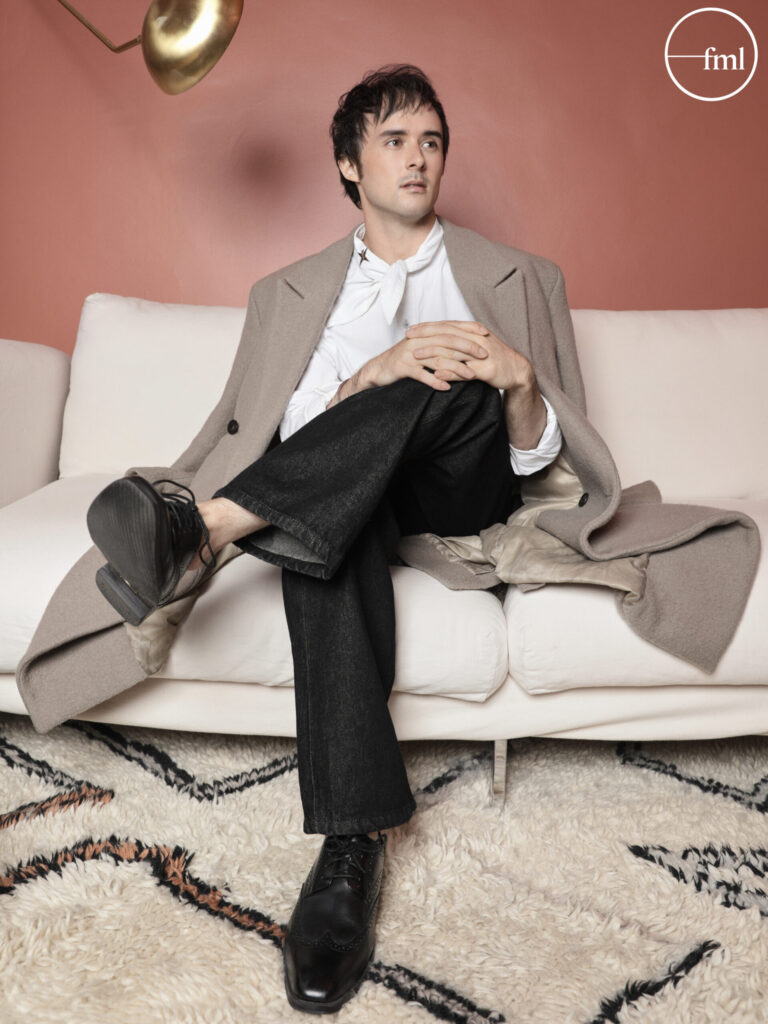
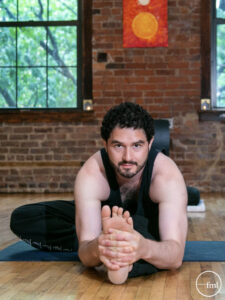
Jacket and Shirt: LUMÈRE, Pants: Second Layer
Raised in New York City, Young’s creative instincts emerged early. While many children spent Halloween trick-or-treating, he was designing theatrical haunted houses, an early glimpse into a fascination with atmosphere, illusion, and emotional experience. That curiosity continued through training with a vaudeville magician and working behind the scenes at concerts and festivals, experiences that laid the foundation for a multidisciplinary practice where performance, architecture, technology, and visual art exist in constant dialogue.
Whether placing A$AP Rocky through a series of physical and psychological tests on the floor of Sotheby’s, orchestrating a performance where forty audience members were bound in shibari before sharing a communal meal, developing holographic installations that explore memory and grief, or transforming natural landscapes with thousands of points of light inspired by underground mycorrhizal networks, Young consistently creates works that challenge conventional notions of participation. His projects invite audiences to reconsider how we inhabit physical space, connect with one another, and assign meaning to the unseen systems that shape our lives.
This philosophy has led to collaborations with institutions and brands including Dior, Sotheby’s, Yale University, Brooklyn Botanic Garden, Big Apple Circus, Double Chicken Please, The Valentine Museum, Virgin Voyages, and Korean music collective DPR, alongside cultural organizations and development partners around the world. Most recently, he served as Executive Producer and Creative Director of Masquerade, an immersive reinterpretation of Andrew Lloyd Webber’s The Phantom of the Opera. A graduate of Yale University, where he studied Computing and the Arts, Young received the Susan J. Smith Arts Prize and was later honored with the LIT Award for Living Memory, a work that explores the intersection of technology, remembrance, and human connection.
The questions Young poses through his work continue to evolve. His forthcoming Collections Series 001 expands his practice into apparel and custom furniture, imagining interiors where architecture and plant life exist not in opposition, but in collaboration. Inspired in part by Italian plant neurobiologist Stefano Mancuso’s research, the collection envisions a world where human environments are no longer isolated from nature, but shaped by it. Rather than treating plants as decorative elements, the series considers what our living spaces might become if they reflected the ecosystems that have quietly sustained life all along.
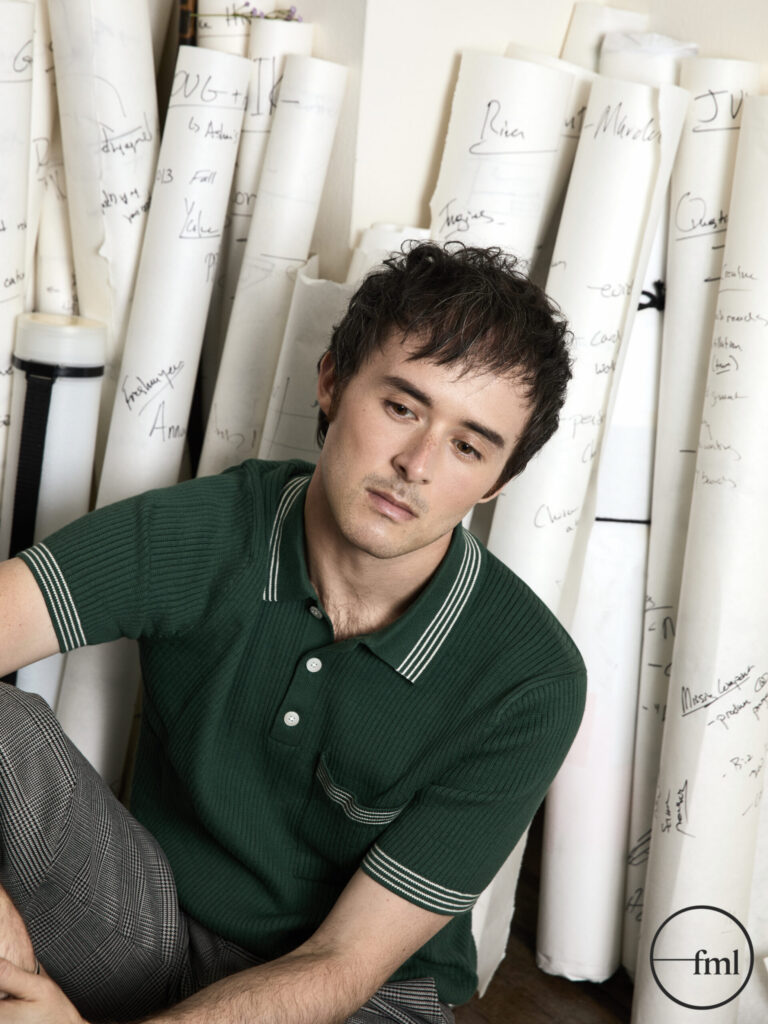
Top: Madewell, Pants: MIDNIGHT RODEO
With several new theatrical productions currently in development, alongside ongoing collaborations spanning fashion, music, cultural institutions, and international development, Young continues to build experiences that resist categorization. Regardless of medium, each project begins with the same underlying question: how can art transform not only what we see, but how we experience the world around us?
FML: You grew up designing haunted houses instead of going trick or treating. What did those early experiments teach you about audience psychology?
AY: “I remember being dressed up as a cow for Halloween one year and hating it and decided I wanted to “trick” instead. So I followed that impulse and started creating haunted houses in empty apartments in New York.”
I learned two major things. First, people are eager to step into stories. I’d create worlds where it was raining inside an apartment or make people climb through tunnels or mazes to escape Mercy Brown – the original alleged New England vampire (spoiler: she wasn’t a vampire, but of course her brother died when the towns people fed her burnt heart to him in a tonic).
Second, the whole experience matters, even before you enter. I made every audience member sign a release waiver. Everyone assumed it was my mother’s (lawyer by trade) doing, but she had nothing to do with it. I just wanted the audience to feel the stakes. I wanted to change their perception of the experience before they even walked through the door. I remember kids trying to read it to their parents, parents laughing but confused about if they should actually sign to go in with their kids.
Experimenting with all these different components of the experience really was a testing ground for me. It was my first real dialogue with a large audience.
FML: You trained with a vaudeville magician as a kid. How does the logic of magic and illusion still influence the way you design experiences today?
AY: I love magic because even when people know they’re being fooled, they want to be. It’s the perfect tension between the suspension of disbelief and an intentional desire to believe. My early mentor, Roy Dexter, taught me the technical skills, but his most important lesson was how to seed the end of a trick at the very beginning.
I once spent an entire week researching the signatures of two party hosts just to perform a thirty-second trick with a twenty-dollar bill. The trick was to transform the signatures of the Treasurer of the United States and the Secretary of the Treasury into the hosts’ signatures with a twenty-dollar bill they gave me. The goal was to make a highly calculated, researched move feel entirely impromptu and alive. That’s the core of magic: the invisible work required to make something look effortless.
I use that same method today. Whether I’m building a set that collapses to reveal a single mirror so a performer can confront their reflection, or sending hundreds of lemons out with a hidden note in the center, the intent is the same: high-level choreography that feels like an impossible, natural occurrence.
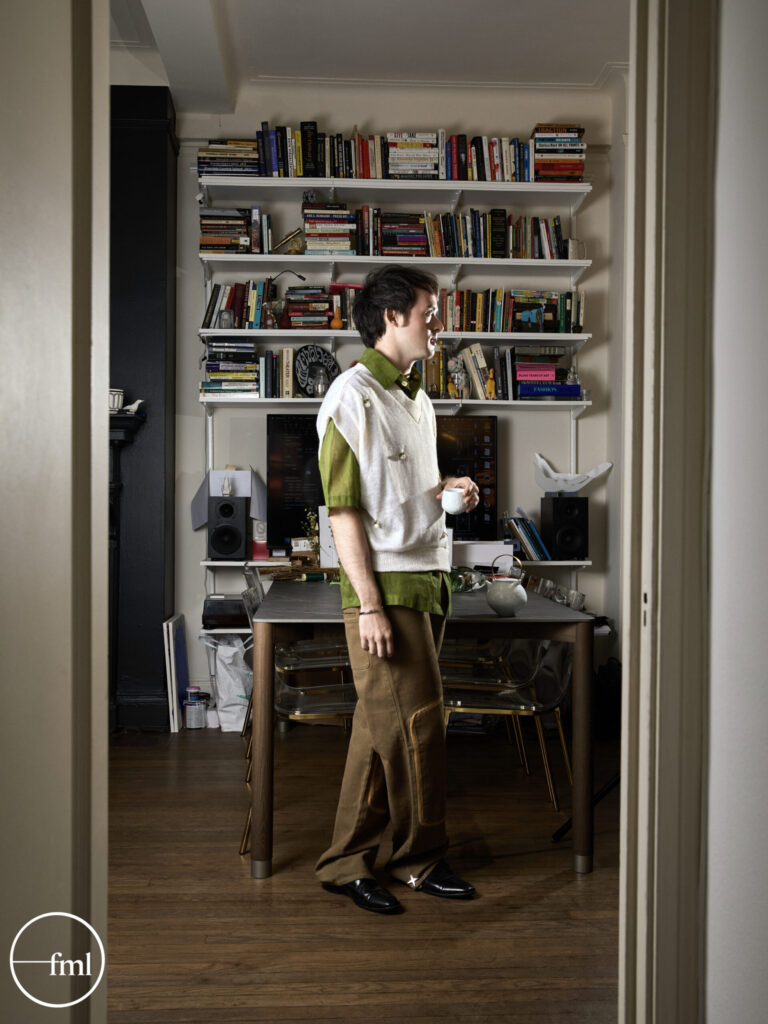
Sweater and Shirt: Clara Son, Pants: LUMÈRE
People are eager to step into stories.
FML: What was the first moment you realized you wanted to create immersive worlds rather than traditional performances?
AY: One of those moments was on my 13th birthday, I went to see Fuerza Bruta at the Daryl Roth Theater. I walked into a stageless room with pulsing lights and no seats. Out of the darkness, a man on a treadmill began sprinting through walls, and a glowing pool lowered from the ceiling with dancers swimming inches above our heads. When the audience started dancing in the rain, I saw a way to synthesize everything I was already doing—magic, haunted houses, music, and theater—into a single environment. It proved that a performance could be a world that the audience inhabits, not just a show they watch.
FML: Your work moves fluidly between theater, computing, music, and visual art. How do you think about your role across these different disciplines?
AY: I see these disciplines as different expressions of the same process. It starts with a strong, clear concept, and then an honest assessment of which medium tells that story best. For COLLECTIONS – Series 001, we initially imagined an apartment colonized by plants. Eventually, we realized the most potent expression of that idea wasn’t the space itself, but the furniture and clothing within it.
My title shifts to fit the context — I might be creative directing a concert, designing an object, or curating an exhibition, but the mission is always the same: establish a core artistic principle and translate it into the rigorous craft required to make it exist.
FML: In Masquerade, audiences traverse an entire opera house environment. What were the biggest challenges in translating a classic musical into an immersive format?
AY: The gift was the source material—the story, the music, and the building were already there. The challenge was the form. After a year of workshops, we landed on a promenade format, which allowed the audience to literally walk through the narrative of the opera house.
In a space that large, the team wasn’t just directing actors; we were choreographing the flow of an audience in sync with a musical score. It’s a massive logistical puzzle. We had teams of people with stopwatches timing audience members through every hallway to ensure the timings worked. We were running the show six times a night, separated by exactly 15-minute and 30-second increments to ensure no overlaps. The score became our master clock.
But through all that precision, the show had to remain human. All the mechanics had to work in the background in service of the story. Diane, our amazing director, was clear: the mask was the anchor. It wasn’t just a prop for a ball; it was a way to explore the things we all hide. By asking everyone to wear one, we were actually inviting them to look at each other—and themselves—without their social facades. It becomes a question of self-acceptance: What happens when the version of yourself you present to the world is stripped away?
FML: Your holographic work Living Memory explores grief and memory. Guide us through this project, and what conversations did you hope that project would open?
AY: The project began as a reimagining of J.M. Barrie searching for his late brother in a greenhouse. I wanted to represent the deceased as they feel: present but untouchable. Following personal losses and the collective losses of the pandemic, I evolved the concept into a public installation to serve as a home for these memories.
The work is a delicate process that starts before the doors even open. A close friend of mine realized he wasn’t ready to confront the memory simply by trying to submit a photo; for others, the piece provides a physical space to be with a loved one again.
Ultimately, the installation acts as a memory capsule. Everywhere it goes, it collects the specific stories of that community. My hope is that it opens a conversation about grief and how we hold onto those we’ve lost—creating a place where they are present, and we can sit with them again, if only for a moment. I was very touched when Jason Tougaw (Psychology Today) wrote after seeing the piece: “Solitary grief became communal. We talked about our grief among friends and newly intimate strangers… It felt like a gift.”
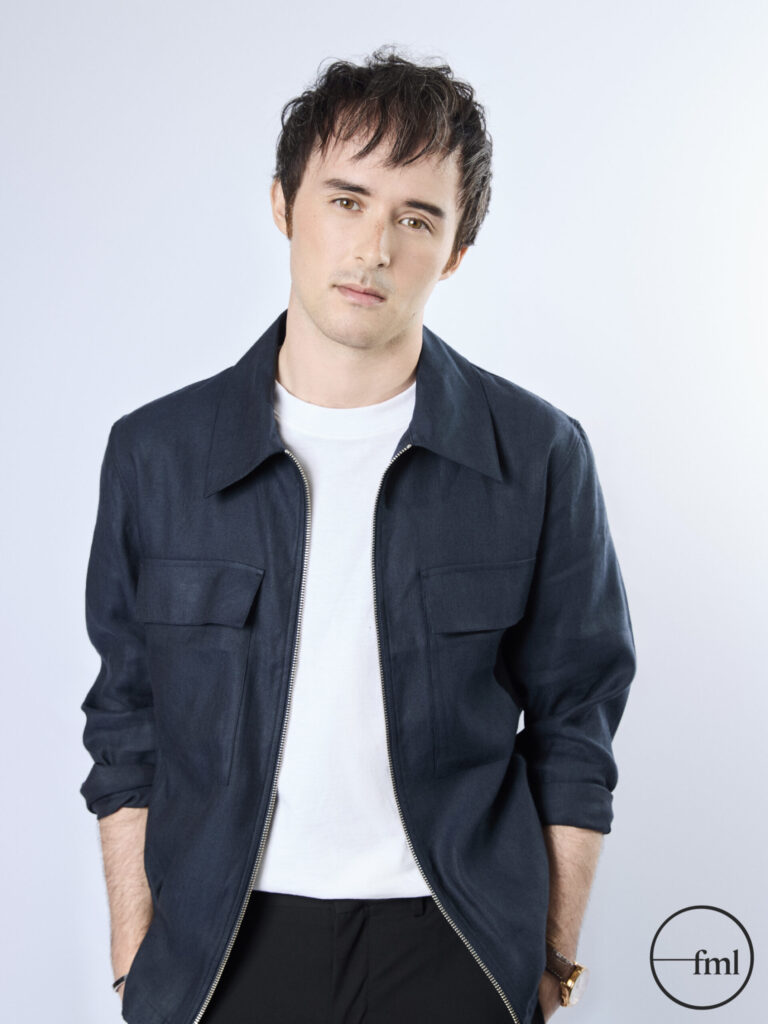
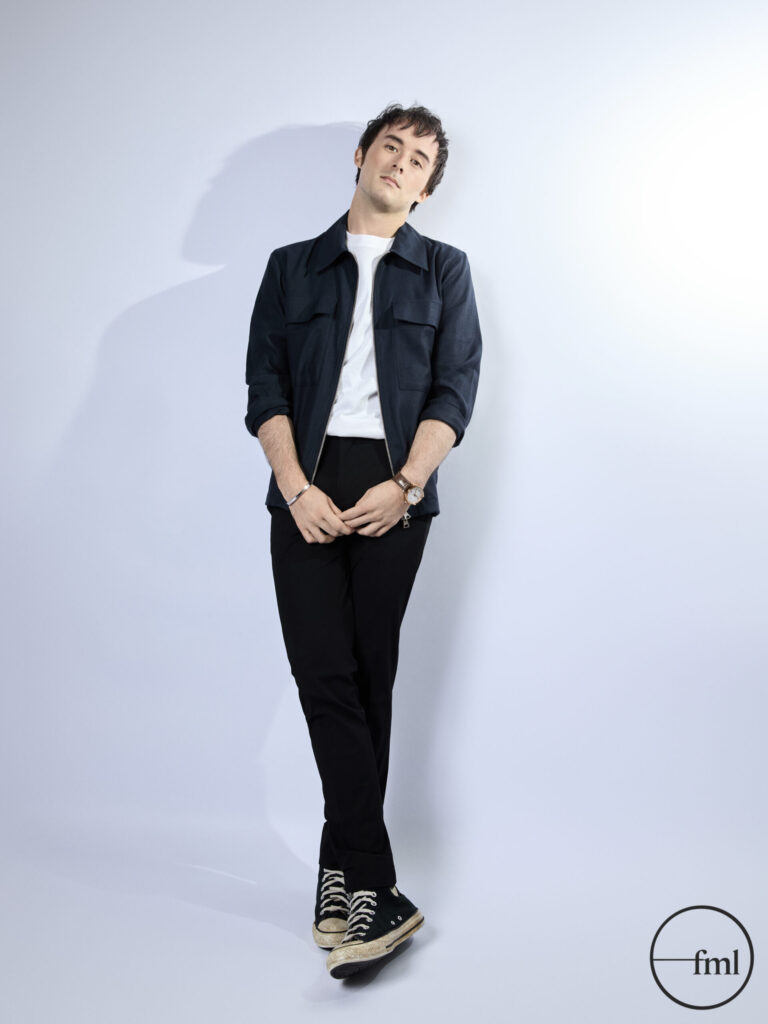
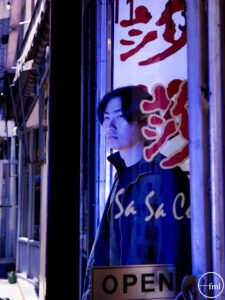
Jacket: nn07, Pants: THEORY
FML: Your collaborators range from fashion houses to musicians to research institutions. What qualities or shared values make a collaboration meaningful for you?
AY: The best work happens when we’re honest about whether our studio is the right fit for a project. I look for collaborators who share our obsession with the rigor required to make something not only beautiful but intentional. For a project like Flock, the developer and I wanted to anchor the work in its environment, so we consulted an ornithologist and modeled the sculptures after the boat-tailed grackle. These birds congregate near the water with a communal, playful spirit that mirrors the families living there; it turned the installation into a reflection of the neighborhood.
We apply that same logic to every medium. At Masquerade, the black and silver dress code wasn’t just about the audience matching the set; it was an intentional part of the invitation. The audience became participants—many of them spent time planning outfits and decorating masks, arriving already invested in the world we’d built.
At the Valentine Museum, the goal wasn’t just to display marble statues. We worked with curators and architects to visually deconstruct the history of the pieces, using projections to reveal false narratives every time a piece was illuminated, educating visitors about their true history. It takes a high level of commitment to navigate these devising processes, and I love collaborators who find joy in that.
FML: How does working with collaborators from different disciplines influence the ideas that emerge in a project?
AY: I’m always looking for collaborators who bring other worlds into the conversation. The most rewarding discoveries happen when our references come from outside the discipline we’re currently working in—if we’re designing for theater, the work is richer if we’re looking at art, science, or history for inspiration.
I want to know what my collaborators are obsessed with.
Is it Nagoro, the Valley of the Dolls in Japan, where a woman populates an empty town with life-sized figures to keep its memory alive? Is it the mechanical wonder of 18th-century automata? Or is it the architecture of a temple doorway in Bhutan, designed to force a specific step so you don’t let the ghosts in?
I believe the best ideas come from that level of specificity. The real value isn’t just the reference itself, but how you layer these niche details to serve a larger narrative. Grounding a project in these specific human stories and craft is what makes the work more impactful.
FML: What is the most unexpected collaboration you have had so far?
AY: Real estate development. It sounds corporate, but I’ve found it’s actually theater at a permanent scale. The goals are identical: creating an environment that informs how a community interacts and feels.
But unlike a stage performance that concludes after two hours, the built environment is a long-term framework. It isn’t about building a static fantasy; it’s about providing a rigorous, functional structure that allows a new community, neighborhood, or city to grow into itself. I love the challenge of world-building where you aren’t the sole author—you are setting a stage, building on real history, where families move in, the community takes over, and the story evolves over decades. It’s less about creating a finished environment or narrative and more about building a canvas that allows people to move in and start creating their own culture.
FML: Your projects often involve elaborate technical systems including light, holography, and environmental design. How do you balance innovation with the emotional impact of the story you are telling?
AY: I always start with the story and the emotion I want to evoke. If the narrative and the feeling are clear, the medium becomes a tactical choice. I’m constantly asking: What is the most honest way to express this?
Is it a fog hologram, a marble monument, a piece of furniture, or a live show?
For me, innovation is just a byproduct of necessity. We build new systems because the emotional beat we’re trying to hit can’t be achieved with the tools that already exist. For example, with the hologram for Living Memory, I couldn’t get the image clarity I wanted with off the shelf solutions. We ended up researching healthcare laminar airflow systems and using thousands of straws to recreate that precise air movement. We also had to find ways to regulate the airflow to have the image slowly disintegrate on cue.
That level of technical interrogation—the research, the math, the thousands of straws—was entirely in service of an emotional response. It was about making a memory feel as it actually is: present but untouchable. The technology shouldn’t be the headline; it’s just a lens to bring the story into focus. For me it is successful when the how disappears and the audience is just left with the actual feeling of the moment.
FML: Have you ever had a concept that felt impossible and then found a way to build it?
AY: I don’t think anything is impossible. Maybe I don’t know how to do it yet, but it’s about breaking what’s challenging into pieces I can understand and being patient as things take time.
For a long time, I’ve said my goal is to buy a town and design its entire ecosystem. At first glance, that sounds like an impossible vision, but when you break it down, the studio has already been building the constituent parts for years. Between creating large scale narrative environments of Masquerade, F&B and hospitality with the six-course dinner, circus, shibari, show we developed for Virgin Voyages, and design objects and spaces people want to wear and live with like our COLLECTIONS, we’ve already created many components that exist in a city.
Ultimately, making the “impossible” happen isn’t about a single breakthrough. It’s about the stamina to stay in the messiness of the development until the logistics and the emotion align. Both being the Artist protecting the feeling and story and the Producer to find a way to make it happen.
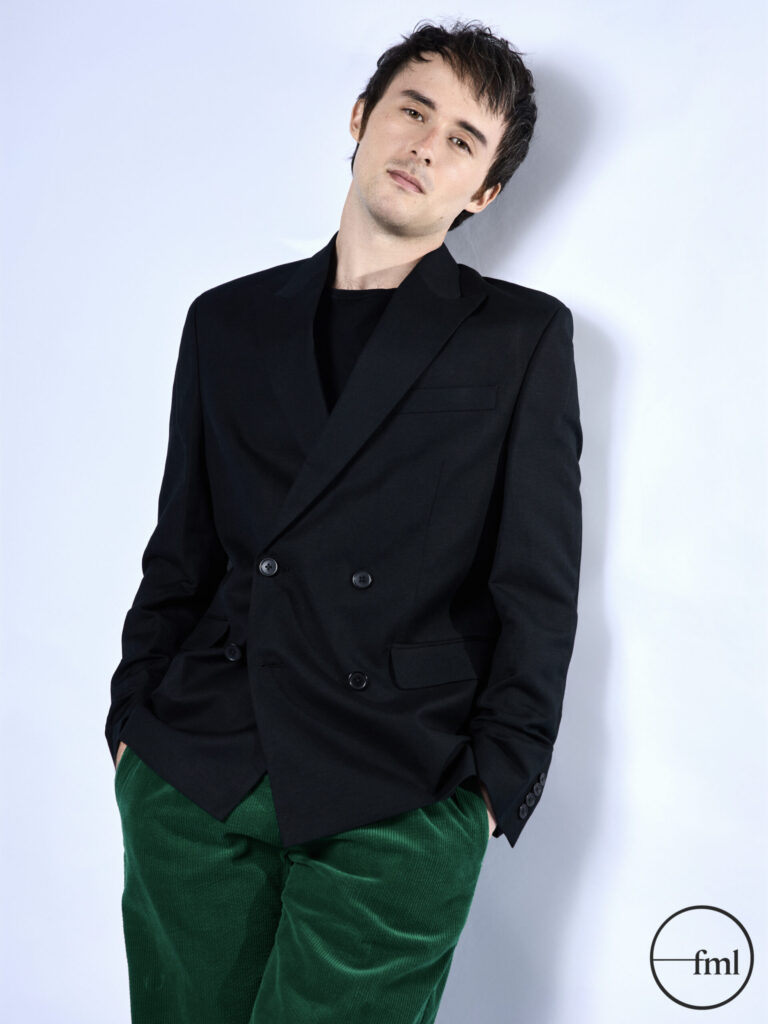
Blazer: THEORY, Pants: Massimo Alba
FML: Your upcoming Collections Series 001 imagines living spaces overtaken by plant life. What drew you to the research of Italian plant neurobiologist Stefano Mancuso?
AY: Stefano is brilliant and such an amazing thinker. We immediately bonded over the fact that he doesn’t treat science like a dry textbook. He approaches his research with a sense of play. He studies plant consciousness—which isn’t about feelings in a human sense, but rather the way plants exhibit consciousness through responses to stimuli and how they perceive their environments.
What really inspired me is that Stefano also has his own art practice. He makes monotypes of plants he finds in local environments. It’s his way of capturing the life that is already reclaiming our cities. By our second conversation, we landed on the idea of an apartment rebalanced by nature. Instead of just putting a potted plant in a corner, we wanted to imagine a space that had been completely overtaken.
This gave me a clear framework for the first series: creating furniture and apparel that feel like they’ve been colonized by plants, alluding to a potential future world. It allowed me to merge my own memories with the specific stories of these plants, moving away from decoration and toward actual co-existence.
FML: Looking ahead, how do you think immersive storytelling will evolve over the next decade?
AY: To me, “immersive” doesn’t mean anything. It has become a buzzword that’s devoid of meaning on its own because everything is being lumped together. I’m more interested in the specific shift toward making the audience the protagonist and applying that to whatever we do.
I see two incredible paths ahead: the first is the large-scale IP boom. It’s amazing to see fans finally getting the chance to physically exist within the worlds they love. The second path is integrating this process into new industries—reimagining what a hotel, a spa, or museum can be for an audience.
It all stems from the reality that human connection is becoming the ultimate luxury. There was a New York Times article a few years ago that really captured this: it argued that as screens saturate our lives, human contact—the act of being present in a room with others—is becoming the most valuable thing we have. That hunger for human connection will drive both of those paths forward over the next decade.
FML: When people leave one of your projects, what do you hope stays with them the longest?
AY: I want people to leave with a story that feels entirely their own. To do that, you have to be willing to go to extreme lengths to make the world feel absolute, rather than just performed.
In college, I did a show called Inferno in an old mansion. For the finale, we would take just one audience member on a private one-on-one—their own Beatrice moment, modeled after the Divine Comedy, where she appears to guide Dante through the final leg of his journey. While they were tucked away, the rest of the audience watched the finale and left.
When that one person finally walked back through the house to exit, the entire building was silent—except for 40 performers and staff standing in frozen tableaux throughout the rooms. That person had to walk through that massive mansion alone, passing all these frozen figures to find their way out. They exited the building, and when they turned around, all the lights in the mansion turned off at once. It was a huge amount of coordination for a single person’s experience. Every time, the audience member was shocked, frozen for a moment processing what had just happened.
Just the other day this moment was brought up to me, not by someone who was there, but by a friend of a friend who heard about it. The show stays with people—not because it was a perfect production, but because both audiences and performers felt the weight of our commitment to the story and their individual experience. When you go to those lengths, the show becomes embedded in their memory.
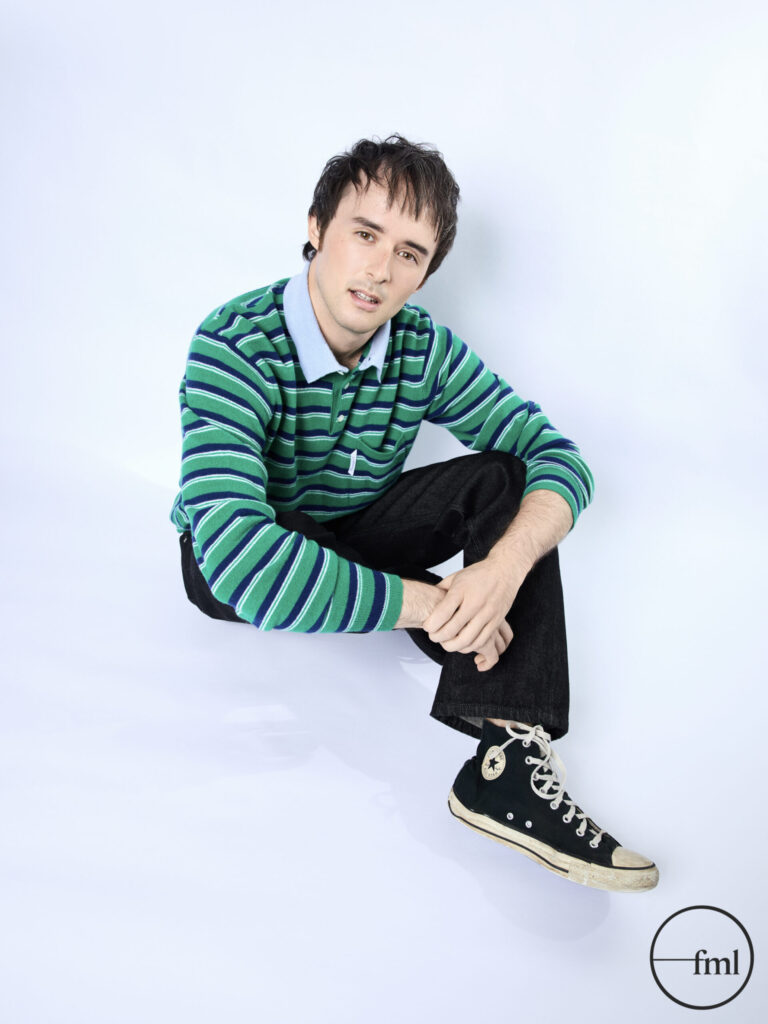
Shirt: Homme, Pants: Second Layer, Shoes: Converse
Throughout his career, Asher Young has embraced an expansive view of what art can be. Moving seamlessly between performance, design, technology, and installation, he approaches each discipline not as a separate practice, but as another language through which ideas can take shape. The result is a body of work that is both deeply researched and profoundly experiential, encouraging audiences to engage not only with the work itself, but with one another.
As his work continues to expand across disciplines, from large-scale theatrical productions to Collections Series 001 and future collaborations spanning art, culture, and design, Young remains committed to asking ambitious questions about the ways we gather, remember, and inhabit the world around us. In an era increasingly mediated by screens and technology, his projects offer something remarkably human: an invitation to step inside a story, and perhaps leave seeing both ourselves and our surroundings a little differently.
Asher’s #FMLFaves
Favorite Song: Ça va aller – avec Pomme by Terrenoire
Favorite Movie: As a kid I would have said Memento / Princess Bride / Prestige, as an adult. The film that caught me most by surprise this year was Weapons.
Favorite Dish: Mapo tofu
What’s in your bag?: Computer, iPad, sketch pad, sunglasses, airpods, battery pack (I never make it through the day), in-ear monitors, tide to go pen, G-20 pens, mechanical pencils, whatever book I am reading.
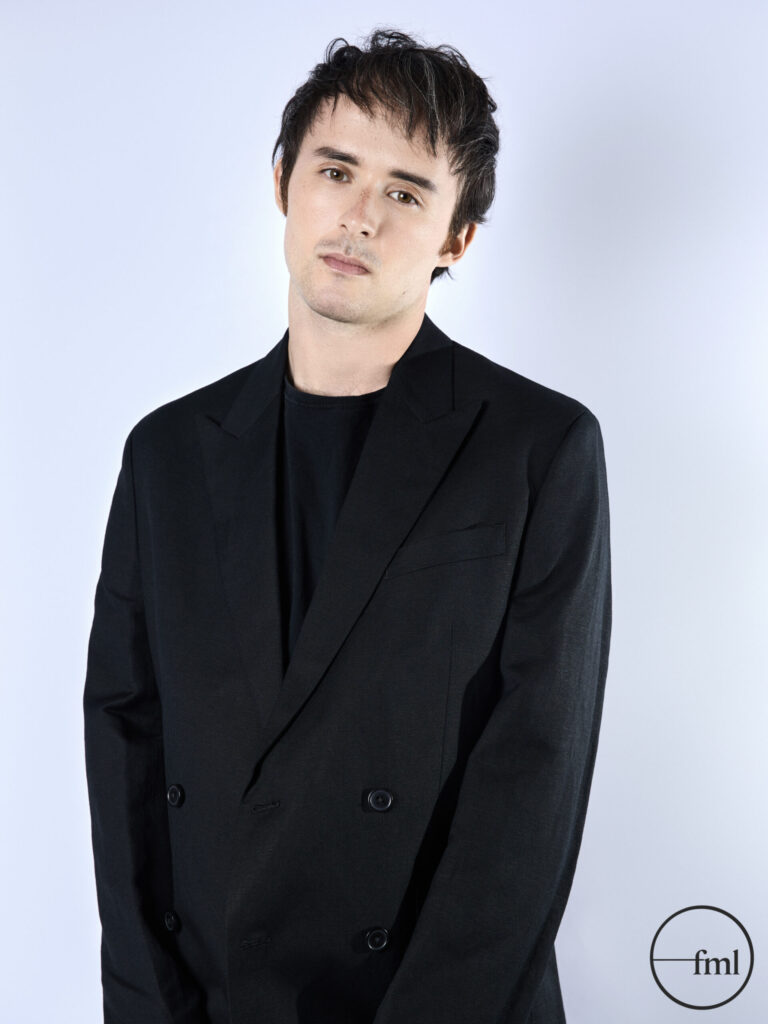
Blazer: THEORY, Pants: Massimo Alba
EIC: Gina Kim-Park ( @ginakpark )
Photography & Creative Direction: Reinhardt Kenneth ( @reinhardtkenneth )
Muse: Asher Young ( @asheryoung.studio )
Production Manager & Lighting Assistant : Deki Namgyal ( @detailsbydeki )
Fashion Stylist: Anica Buckson ( @xx_anaka_xx )
HMUA: Misa Akamatsu ( @blanc_misa )
Lighting Director: Luis Lopez ( @luisisnotthatstupid )
Set Assistant: Valerie Orejuela ( @_valerieo )
Retouch: Valeria Mediana ( @medianaretouch )