ISSUE III: ASHER LEVINE
“Every single time I start something new, it feels like I’m starting for the first time.”
– Asher Levine
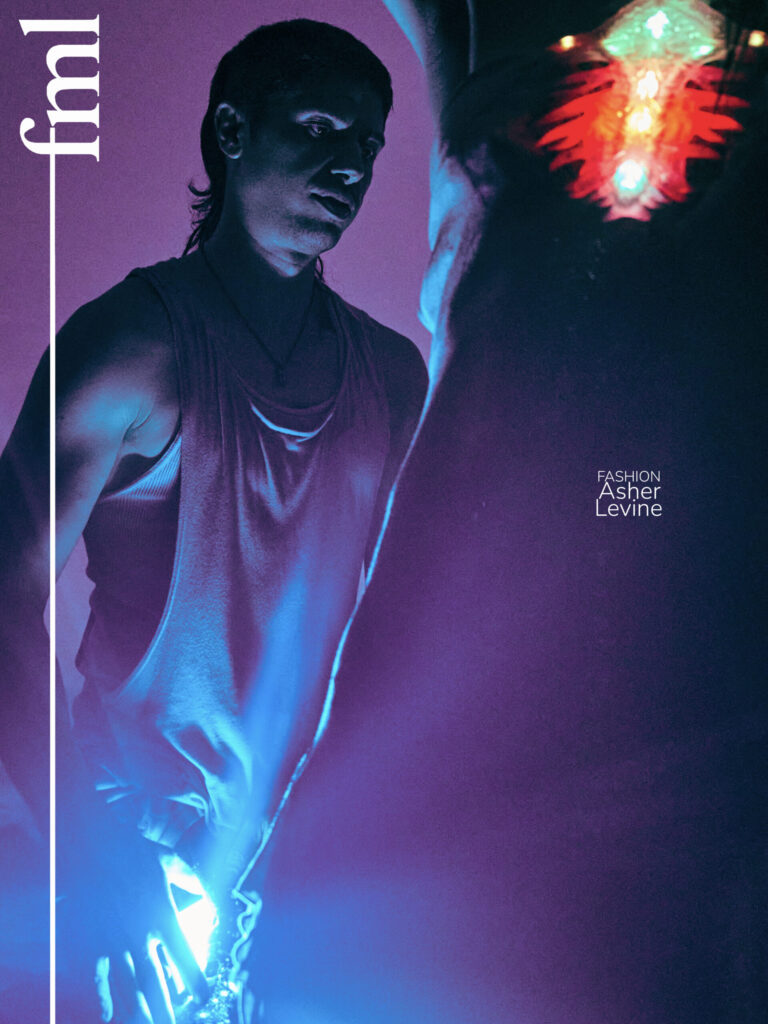
Asher Levine has spent much of his career reconsidering what fashion can be. For more than a decade, his work has moved between clothing, technology, performance and nightlife, often treating innovation as part of the design process rather than something separate from it. For FML Issue III, The Reinvention Issue, Levine brings that thinking into a new chapter with Spring/Summer 2027, a collection that revisits the ideas that have defined his work while presenting them with a noticeably lighter, more relaxed point of view.
Reinvention has been a recurring part of Levine’s career. He emerged in New York with an approach that combined traditional garment construction with experimental fabrication, eventually incorporating 3D printing, molded materials, illumination and other technologies into his collections. His designs have been worn by Lady Gaga, Beyoncé, Taylor Swift, Nicki Minaj, Cardi B, Grace Jones, Doja Cat, Grimes, Lisa, Jennie and Lil Nas X, while his Concept Biker jacket was included in the Museum of Modern Art’s “Items: Is Fashion Modern?” exhibition. Across those projects, the technology has changed considerably, but Levine’s interest in the relationship between clothing and the body has remained consistent.
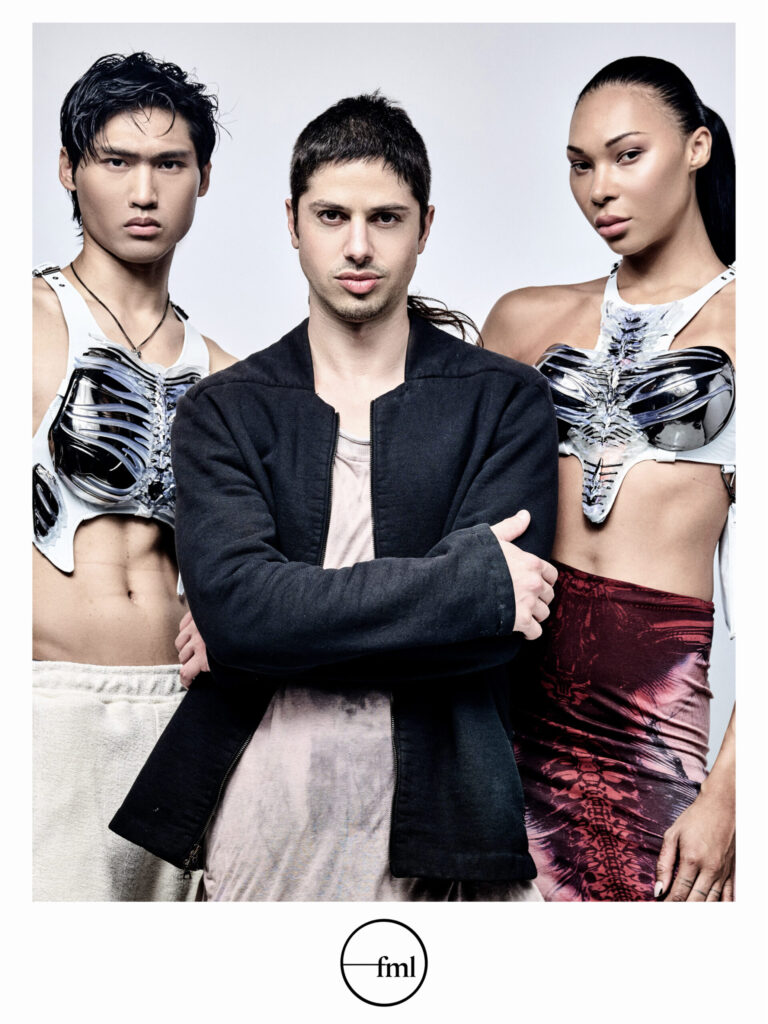
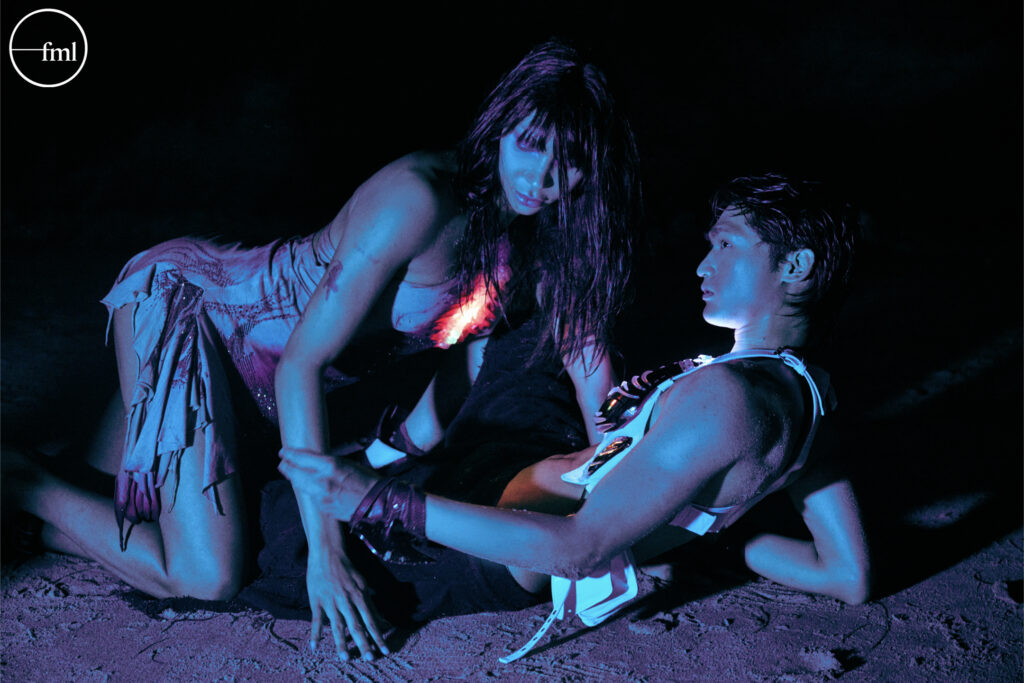
That relationship takes a more understated form for SS27. The collection begins with the kind of pieces that can exist comfortably outside of a stage or installation: draped off-the-shoulder jerseys, relaxed T-shirts and cargos, softened leather and unstructured layers. The palette includes sun-washed rose, while anatomical prints in ink crimson reference veins, muscles, tendons and internal organs. There is an ease to the clothes that contrasts with the sculptural pieces Levine is often associated with, without feeling disconnected from them.
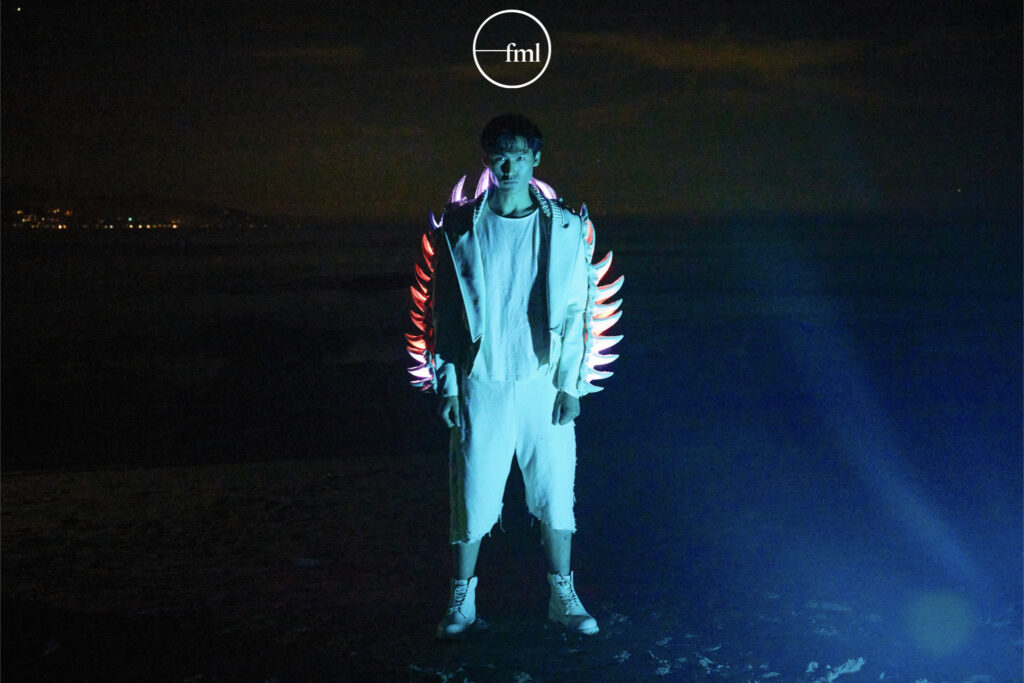
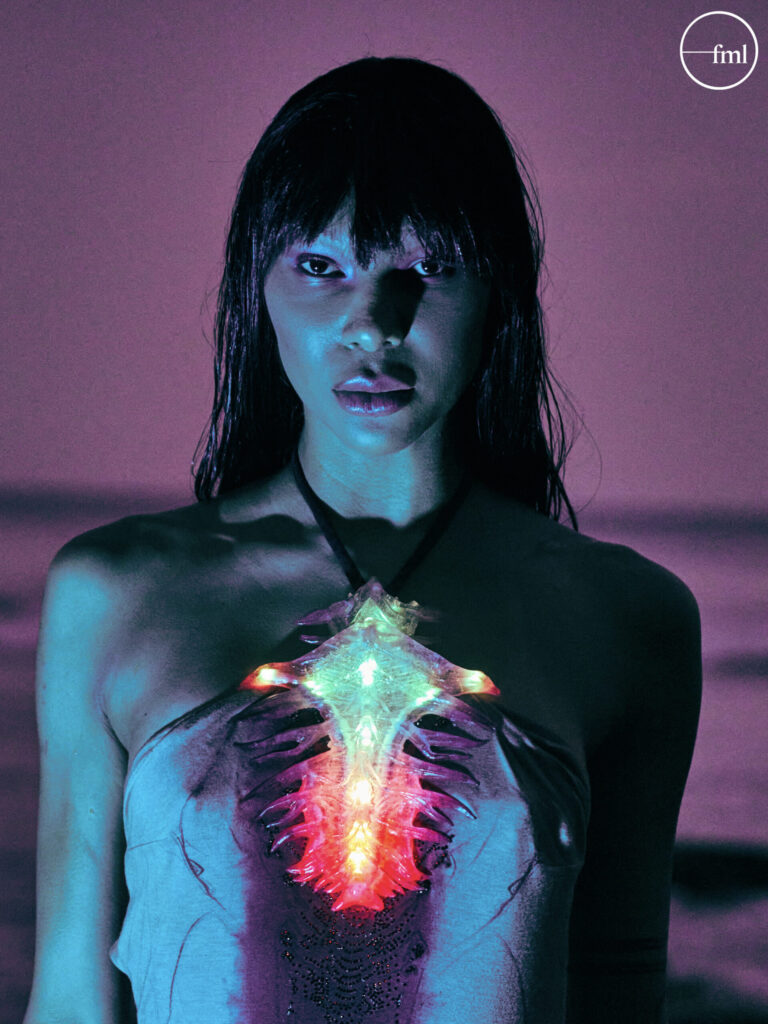
The collection is intended to move from the beach into the night, and that transition gives SS27 its structure. Its daytime wardrobe is minimal and deliberately uncomplicated, with an emphasis on pieces that can be worn loosely and layered. After dark, Levine introduces the custom 4RD illuminated pieces: sculpted biomorphic forms, ribcage harnesses and glowing sternum plates that bring light directly onto the body. Rather than presenting these as a separate futuristic proposition, Levine places them within the same wardrobe.
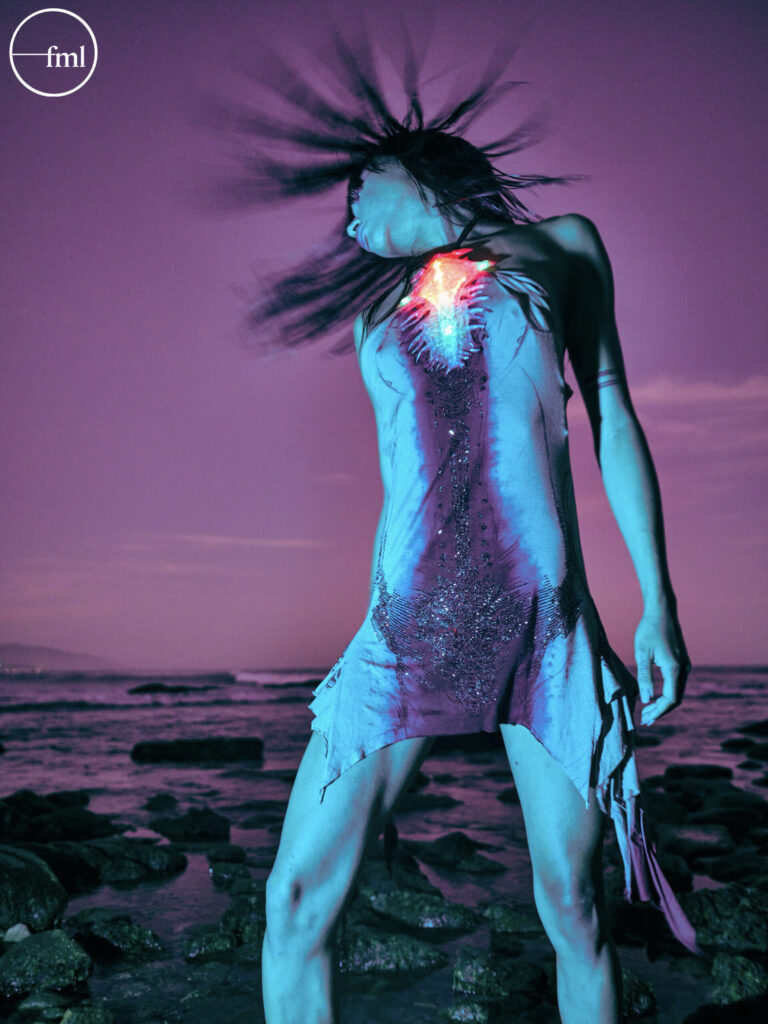
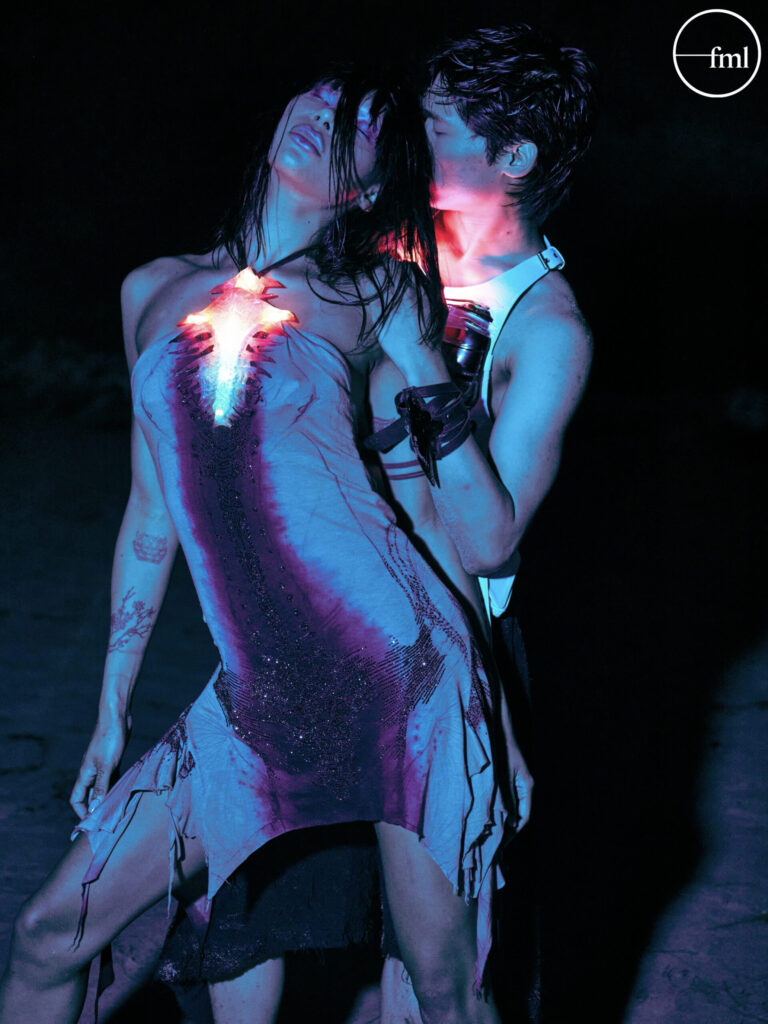
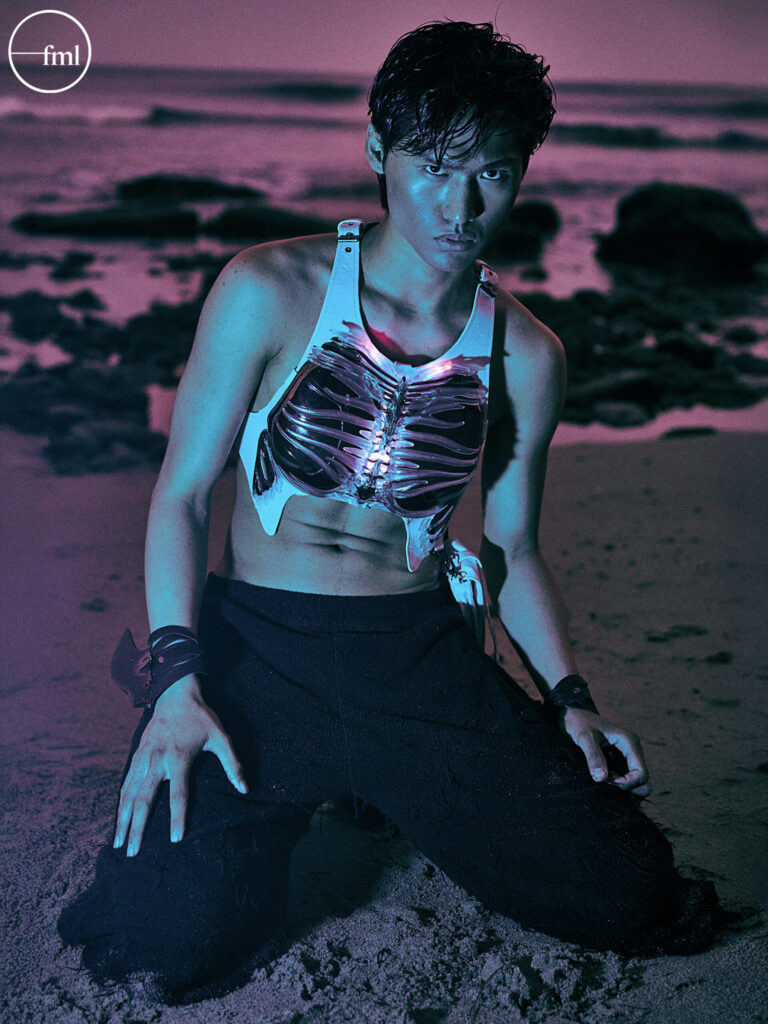
It is a useful progression for a designer whose name became closely associated with fashion technology early in his career. Levine has been experimenting with illuminated clothing for years, including the Concept Biker jacket exhibited at MoMA, but SS27 is less concerned with demonstrating what technology can do than integrating it into the collection as a whole. Light becomes another material alongside jersey and leather, while the technical pieces retain the anatomical references that run throughout his work.
Nightlife is equally present. Levine’s history in New York clubs has informed the collection, particularly the idea of clothing changing according to its environment. The transition from daylight to a dance floor is literal in the illuminated pieces, but it also informs the collection’s attitude. Clothes that begin casual and slightly undone become more constructed and visible as the setting changes.
The contrast between the organic and technological has long been central to Levine’s design language. His silhouettes frequently borrow from anatomy and natural structures even when they are produced through distinctly artificial processes. In SS27, those ideas appear across both ends of the collection: printed directly onto soft garments during the day and reconstructed around the body through illuminated forms at night.
For FML, Levine’s work offers a particularly relevant perspective on reinvention because it does not depend on replacing one identity with another. His career has instead been a process of revisiting the same questions through changing technology, materials and cultural contexts. SS27 continues that trajectory. It is recognizably Asher Levine, but the proposition has shifted: less armor, more ease; less separation between technology and wardrobe; and a broader idea of where his clothes can exist.
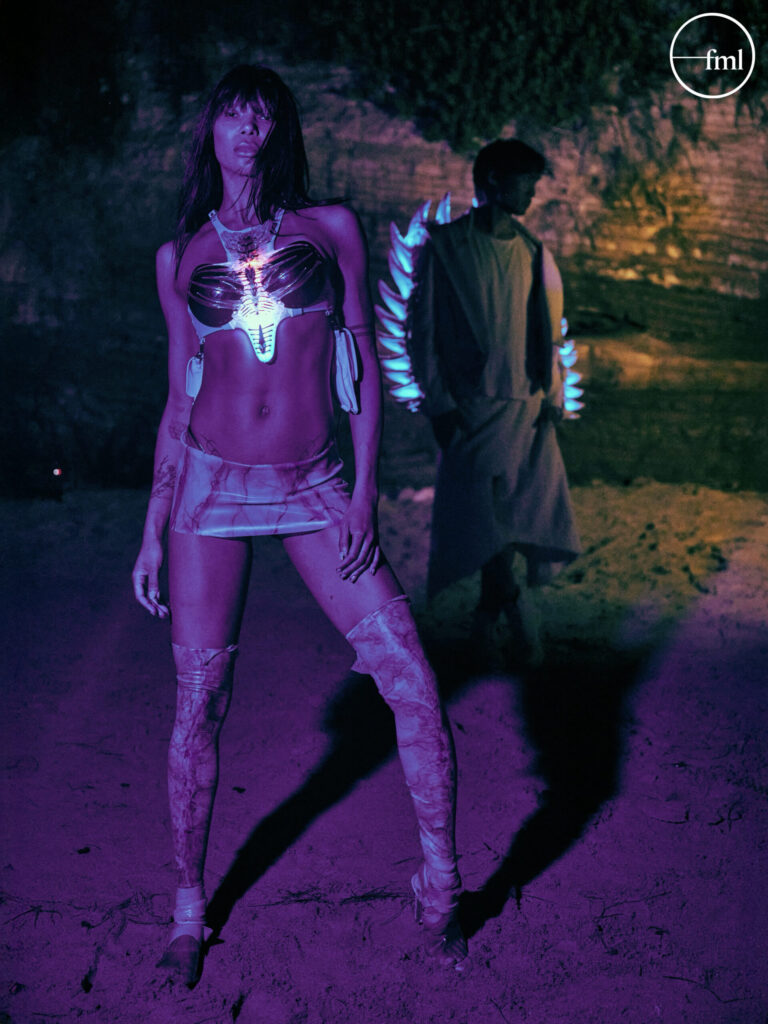
For Issue III, FML sat down with cover star Asher Levine to discuss Spring/Summer 2027, his evolving relationship with fashion technology, the influence of nightlife on his work, the career that brought him here, and what reinvention means to him now.
FML: “Awaken the Light” feels both physical and metaphorical. What does that title mean to you, and how did it become the starting point for SS27?
AL: I look at all of my collections as an evolving point of view on culture at large, on identity, on power, on sex, and this is really just the start of what you’re seeing me develop as a brand. Awaken the Light is about the idea that everyone, everything, carries an internal light, an internal compass, an internal creature. Think about enlightenment: it’s the moment you become your truest light. That’s the starting point. This collection is the new birth of that.
FML: SS27 is rooted in your relationship with New York nightlife and the clubs you came up around. How have those spaces shaped the way you think about fashion and the people you design for?
AL: Although I started showing when I was ten, it was really New York nightlife in the 2000s that gave me the foundation and the platform to explore different silhouettes. Those spaces were places where you could forge your own identity without judgment, where who you were wasn’t defined by sex or gender, where you could express yourself in ways that maybe hadn’t been seen before. I come from that club kid space. Inviting people to participate in a space that has no definition is what excites me, and I think that’s exactly the perspective the future can offer us.
FML: The collection is designed to move from the beach into the night. What interested you in creating clothes that could exist across those two very different environments?
AL: With this collection I really had a beach rave in mind. You’re going to a special event, you’re on vacation, you’re at the beach, and then there’s a rave at night. The draping and a lot of the silhouettes, especially the pants, are perfect for something that starts in the day, carries you through cocktail sunset hour, and then begins to illuminate once night falls.
FML: There is an intentional effortlessness to the daytime pieces this season. What made you want to explore a more relaxed, minimal side of the Asher Levine world?
AL: I’m known for these extravagant, iconic, one-of-a-kind pieces built for the stage. But at the same time, I love beautiful cuts, framing the body in a way that makes the body stand out, that makes the wearer stand out rather than the piece itself. I love living across that whole spectrum.
FML: SS27 includes draped jerseys, relaxed cargos, softened leathers, and unstructured layers. How did you approach making simplicity still feel distinctly Asher Levine?
AL: A lot of these silhouettes are continued styles I’ve carried through my collections since starting the brand in 2010. What I love is the distressed grunge of it all, the tarnished elements. We’re always driving for perfection, yet somehow we love the beauty of the imperfect. I love that dichotomy, polished and grunge, geometric and organic, and I try to capture it in the cuts.
FML: The anatomical prints reference veins, muscles, tendons, and internal structures without becoming completely literal. Where did that visual language come from?
AL: There’s a subconscious curiosity we all have with anatomy, it shapes how we frame and perceive ourselves and the world. Being inspired by these timeless, ancient, prehistoric forms really is the foundation of my design, and it has been since the day I started my label.
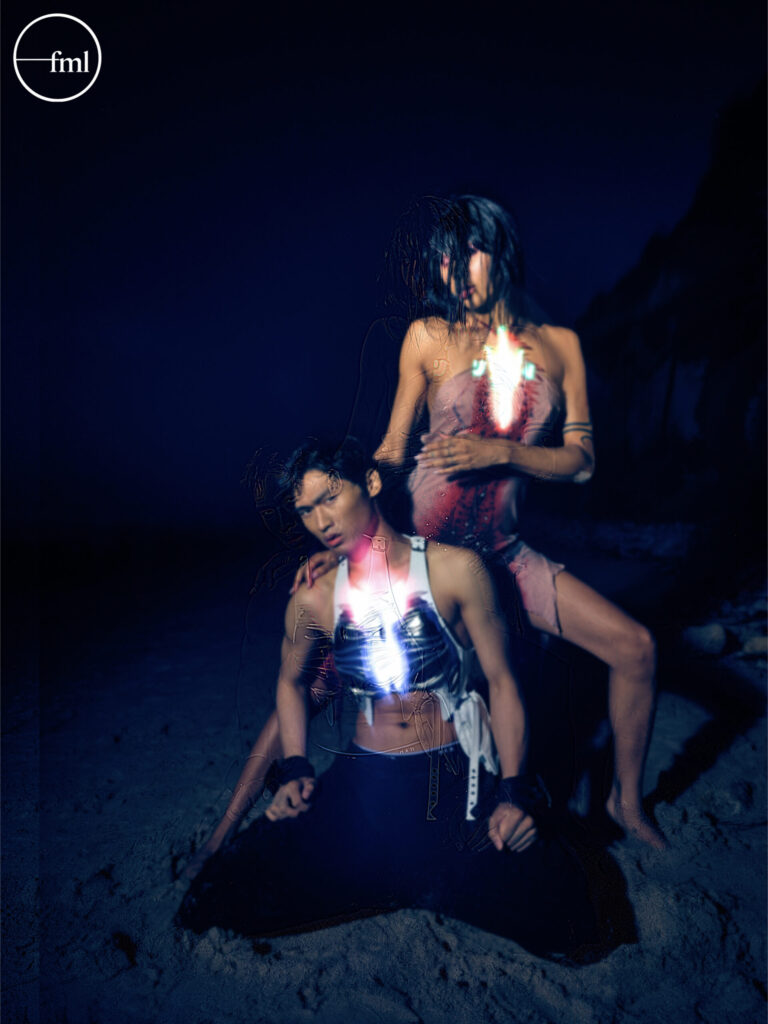
FML: Your illuminated pieces almost feel alive once they are activated. How did you develop the technology and sculptural language behind them for this collection?
AL: We’ve been developing our illumination technology for over ten years now, this collection is the culmination of more than a decade of R&D across materials and embedded hardware. And you’ve hit it exactly: we never want it to feel like lights simply enclosed in a garment. We want it to feel alive, an accent to the wearer, shaping a new visual language.
FML: Light has appeared throughout your work in different forms. What does illumination allow you to communicate that a traditional garment cannot?
AL: I look at illumination as another color, another fabric, another kind of appliqué or embellishment or trim that I can work with. It’s a whole new space, and it’s already permeating culture. A traditional garment can’t change its color. It can’t make you visible in complete darkness. That’s what excites me about this new visual language.
FML: With wearable technology, there can sometimes be a divide between innovation and wearability. How do you make sure the technology remains part of the fashion rather than becoming a novelty?
AL: My studio and I have had years of practice developing wearable illuminated garments for the most stringent, high-performance stages in the world. Through that learning, through countless failures and broken wires, we’ve created processes and techniques that let the technology become part of the design rather than a gimmick. That’s always the goal, how can it augment what is already there?
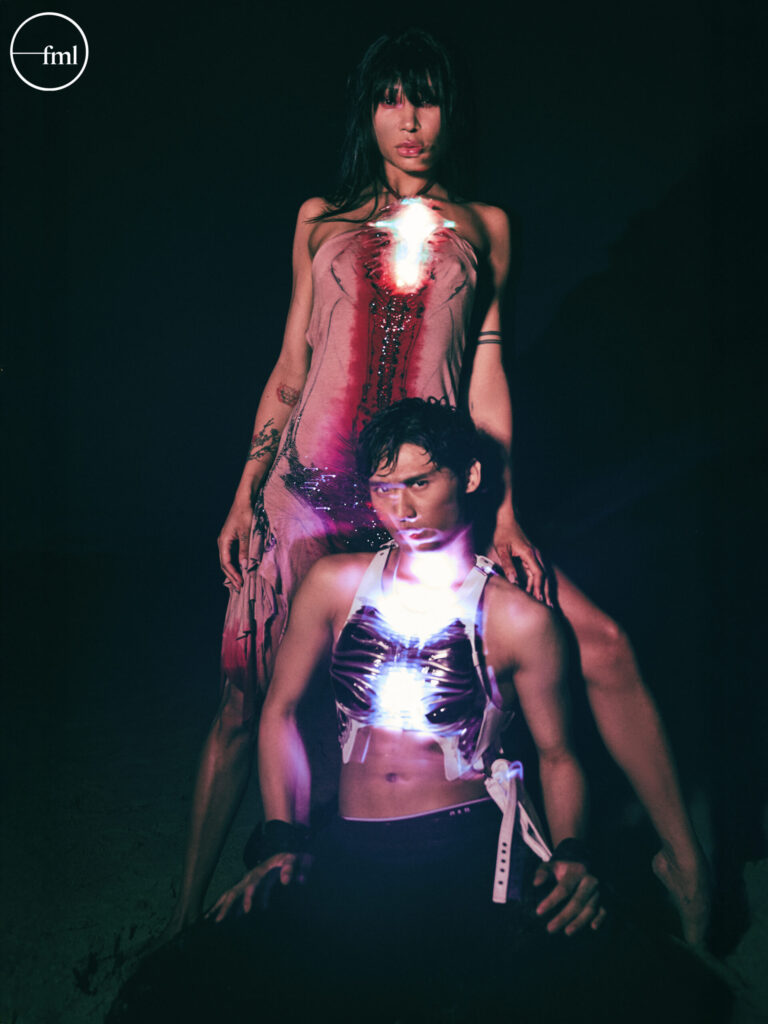
FML: You have worked extensively with biomorphic forms. What continues to fascinate you about bringing elements of anatomy, nature, and the body into futuristic design?
AL: First, I’m so happy it’s become a dominant theme of the twenty-first century. When my second collection was hanging next to Iris van Herpen’s original collection at the Blow PR showroom in London in 2011, I remember thinking, look at this other designer inspired by the same forms. For those of us designing for the future, looking to the past, to where life comes from, is endlessly fascinating. To me, all the answers of the universe are locked within its patterns. That’s why it holds me, it provides endless curiosity, and it’s also incredibly beautiful. When we look at nature and its fractals, it brings fascination, curiosity, and more beauty into the visual world.
FML: SS27 is described as being centered on empowerment. What do you want someone to feel when they put on one of these pieces?
AL: That’s really been my main role, especially in the entertainment realm. When a musician or an executive comes to me and puts on one of my pieces, they become more powerful, they feel their power exude beyond their skin. It’s a layer of confidence that comes from knowing you’re representing a style that has never been worn before. You are a pioneer. You are pushing the limits of culture and expanding the consciousness of humanity through your performance, through your visual language. That’s what I want every person to feel when they wear Asher Levine.
FML: Your work has always imagined fashion slightly ahead of where the industry currently is. When you design, how much are you thinking about the present versus a world that does not exist yet?
AL: Such a good question. A lot of these motifs, the dissections, the anatomical language, we were doing ten years ago. It’s fascinating to look at your work from a decade ago next to now, see how similar it is, and yet see how differently the world receives it. It tells me two things: that I’ve made an influence in getting us to where we are today, and that people are ready. There’s always an element of timing when it comes to visual taste. I actually have designs and ideas for pieces that could exist in twenty or thirty years, but I tend to love living in the space of what things will look like in the next five to ten.
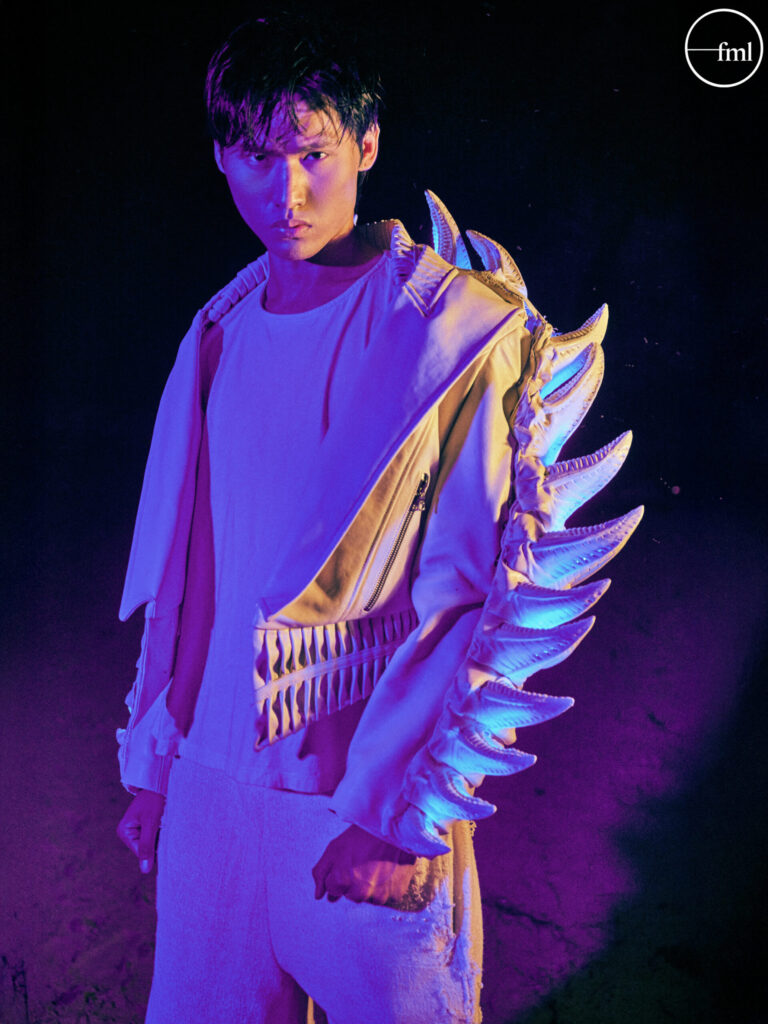
FML: From LED illumination to 3D printing and experimental fabrication, technology has become inseparable from your design language. What technology or material are you most excited to push further right now?
AL: We’ve played with so many technologies and new materials across all of our goods, but right now I’m most excited about illumination. It’s an area we’ve specialized in for nearly fifteen years, and now I feel like we’re ready, we’re building a new kind of illuminated visual ecosystem that’s already influencing the world. To me, it’s all about awakening everyone’s light.
FML: Your designs have been worn by artists including Lady Gaga, Grace Jones, Cardi B, Doja Cat, Lil Nas X, Lisa, and Taylor Swift. What have those collaborations taught you about designing for performers and larger-than-life personalities?
AL: They’ve taught me to trust my gut in terms of what to put out there. I’m so grateful that these clients now come to me wanting my taste, my perspective, and what’s so enthralling is watching them not only accept it but let it become part of them. My entire studio pours so much effort into these iconic moments. And honestly, the biggest lesson is gratitude. It’s incredibly hard, things break, and we’re solving new kinds of problems multiple times a day because we’re pushing a boundary in every single project. But at the end of the day, I’m just super grateful.
FML: Your work was part of LISA’s Coachella moment, a performance watched on a massive global scale. What was the process of creating for that stage, and how did you balance your own design language with LISA’s identity as a performer?
AL: I was given design briefs, they already had a concept built around Lisa’s different personalities, and I was to create two of them. What was incredible is how perfectly the aesthetics aligned, before I even knew the concept, we were already developing futuristic pod forms in the studio. When those synchronistic moments happen, when you’re developing something on your own and someone arrives with a similar vision, it means the alignment is perfect. I also loved working with Brett Alan Nelson, and we have worked together for years. I am so grateful to the stylists to trust me with their vision and space.
FML: Your work has also entered institutions like MoMA, placing it within a broader conversation around fashion, technology, and design history. Has seeing your work in that context changed how you view your own practice?
AL: I’m not going to lie, it’s definitely validating to have some of the most prestigious museums showcase your work. But I’ll always feel like that young boy who just picked up a needle for the first time. Every single time I start something new, it feels like I’m starting for the first time, the nerves, the anxiety, the unknowns of how it will come together. It’s always a journey. Every piece, even a basic T-shirt with a cool finish, still feels exactly the same to me.
FML: You are making your first New York Fashion Week DJ appearance alongside the debut of SS27. What does DJing allow you to express that designing does not?
AL: I started DJing a year ago, after years of wanting to find a hobby. It turned out to be the perfect one, anything else I tried that dealt with physical matter felt too much like work. DJing feels like being a music stylist. I come from music parents, my dad is a drummer, and my mother is a dancer, so it’s in my blood. I wanted to explore that and share my love and taste for electronic, techno, and house music.
FML: Fashion and nightlife have historically influenced one another, especially in New York. Do you feel that relationship is changing, and where do you see your work fitting into it today?
AL: My work is definitely meant for the night, that’s where you can glow and be seen. But I love all of my pieces and all of my styles, my blazers, my leather jackets. I see them on the road, on motorcyclists and cyclists who want to be illuminated. I see them at sports arenas, at your special moments, when you’re having fun and expressing yourself. Going out to a game, going to the rave, going to the club, going out to dinner. I want people to wear my clothes in the spaces where they want to express themselves and be seen.
FML: After years of pushing fashion technology forward, what still feels unexplored to you? Is there something you have imagined making that technology has not quite caught up to yet?
AL: That’s a really good question. Honestly, all the tools are here now, we have everything we need, and I feel so appreciative of that, from the digital to the hands. And remember, we use our hands. It’s all about handcraft; technology is only a tool for us. The only thing that feels unexplored now sits in the realm of the designer, what to do with all of these tools. That’s what excites me.
FML: If SS27 is about awakening the light, what do you hope this collection illuminates about where Asher Levine is heading next?
AL: We are going to light the future. I’m doing this to make us excited about the future. It’s a dark time right now, globally, economically, politically, and I want my clothes to be a beacon of light, to give hope to everyone. The future is ours, and it’s ours to make.
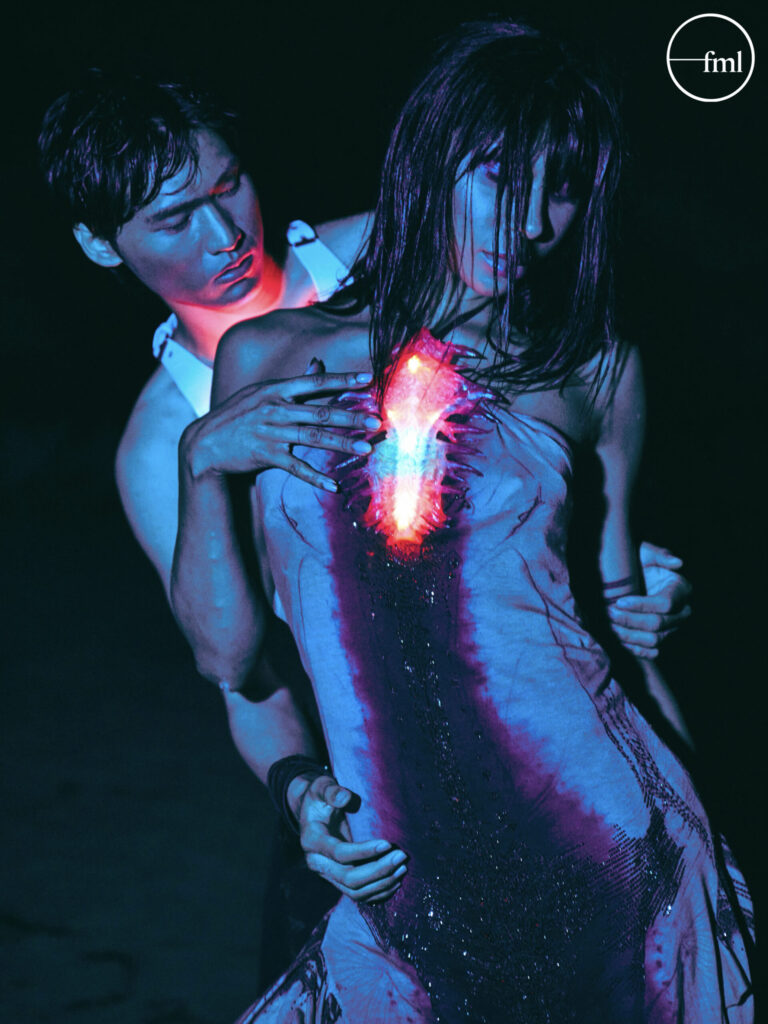
After years of experimentation, broken wires, new materials and one-off pieces built for some of the world’s biggest stages, the technology is no longer the entire story. As Levine puts it, “technology is only a tool for us.” What matters now is what a designer chooses to do with it.
That perspective makes SS27 an interesting point in Levine’s career. The illuminated pieces may command attention, but alongside them are the jerseys, leather jackets, cargos and deliberately imperfect finishes that have existed within his vocabulary for years. His references remain familiar too: anatomy, nature, nightlife, the body. Reinvention here is not a rejection of those ideas, but a reconsideration of how they can live together. The future Levine imagines is not necessarily one where technology replaces craft or clothing becomes increasingly complicated. It is one where the boundaries between them become less visible.
For FML’s Reinvention Issue, that feels like an appropriate place to land. More than a decade into his label, Levine is still working with ideas that can be traced back to its beginnings, but neither the technology nor the world around them is the same. His closing thought is perhaps the simplest expression of where he stands now: “The future is ours, and it’s ours to make.” For a designer who has spent much of his career attempting to dress it, the next question is what he chooses to make of it.
Asher’s #FMLFaves
Favorite Song: Afters by Because of Art
Favorite Movie: The Matrix
Favorite Dish: Bulgogi and Broccolli
What’s in your bag?: Mykita Glasses, Weed Vape, Extra Gum, Paper & Pen